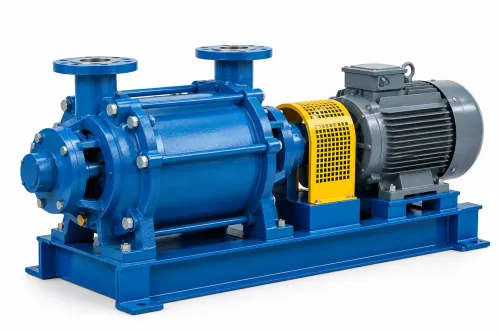
Vacuum systems do not always handle clean, dry air. Many industrial processes involve moisture, vapours, or gases that make pump selection more demanding. Water ring vacuum pumps are one technology commonly considered when process conditions involve wet gas streams.
Selecting them correctly requires understanding both their advantages and their operating requirements.
How Does a Water Ring Vacuum Pump Work?
A water ring pump uses a rotating impeller and a sealing liquid to create the pumping action.
Although water is commonly used as the sealing liquid, actual system design depends on process compatibility and operating requirements.
As the impeller rotates, the liquid forms a ring inside the casing. Changing volumes between the impeller blades and liquid ring allow gas to be drawn in, compressed, and discharged.
This operating principle makes the technology different from dry and oil-lubricated vacuum pumps.
Why Are They Considered for Wet Processes?
The presence of a sealing liquid can make water ring technology suitable for certain processes involving moisture and condensable vapours.
Potential application areas can include:
- Process industries
- Chemical operations
- Filtration systems
- Vacuum drying
- Evaporation
- Degassing
- Food processing
- Pulp and paper processes
- General industrial process vacuum
Specific process compatibility must always be evaluated before selection.
A Common Mistake Is Ignoring Seal Water Conditions
Water is part of the pumping process, so its condition matters.
Temperature can influence vacuum performance. Water quality can also affect scaling, corrosion, deposits, and maintenance requirements.
Plants should therefore consider:
- Seal water temperature
- Water quality
- Supply consistency
- Drainage
- Recirculation requirements
- Process contamination
Simply connecting the pump to an available water supply without assessing these factors can create avoidable operating issues.
Once Through and Recirculating Arrangements
Depending on process and plant requirements, sealing liquid arrangements may be designed differently.
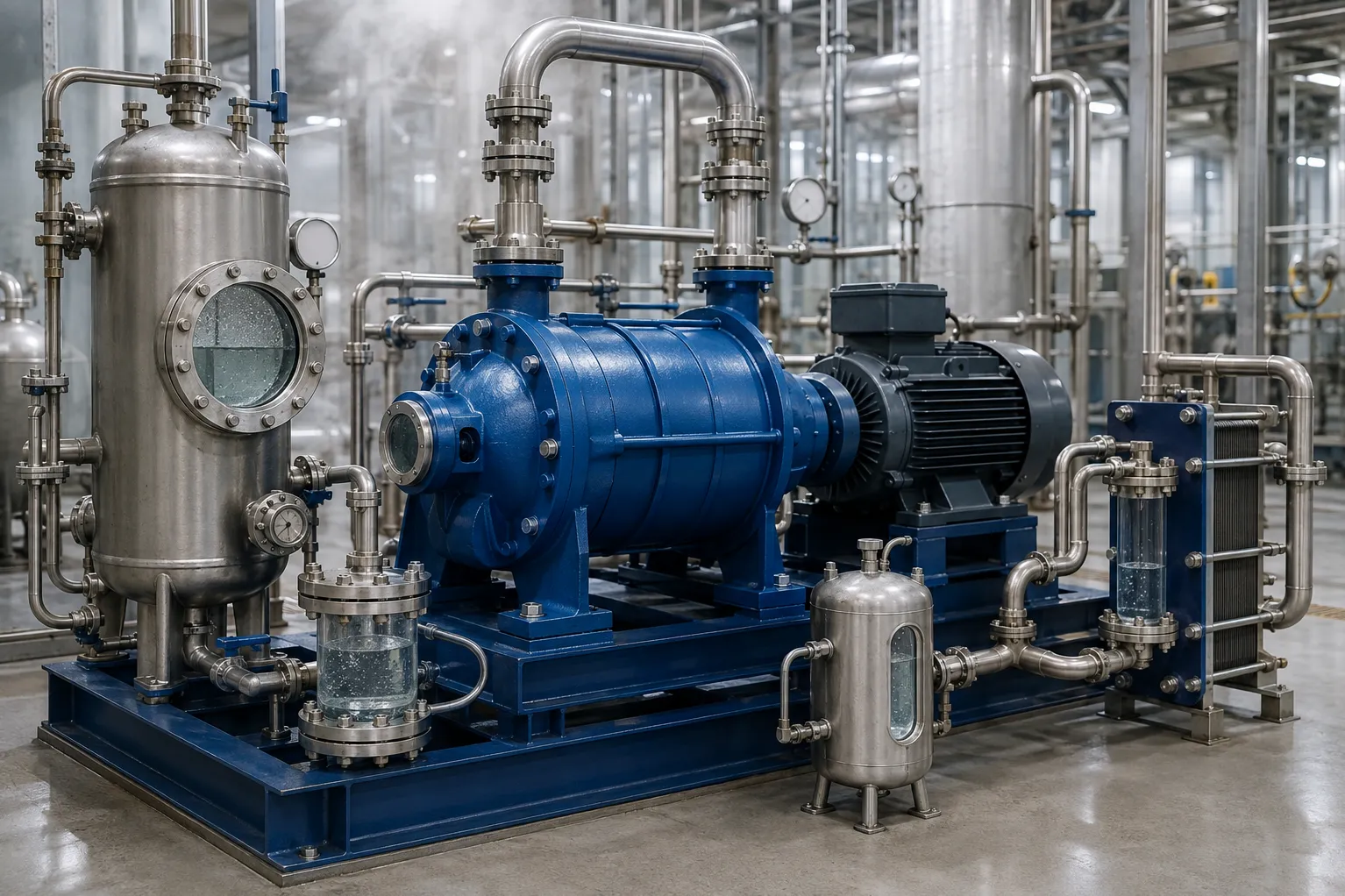
A once-through arrangement uses fresh liquid and discharges it after use. A recirculating configuration reuses some or all of the sealing liquid through an appropriate system.
Water availability, operating cost, process contamination, temperature control, and environmental considerations influence which arrangement makes sense.
For factories concerned with water consumption, this part of the design deserves attention early in the project.
Do Not Size Only by Connection Diameter
Existing pipe size is not enough information for selecting a water ring pump.
Engineering teams should define:
- Required operating pressure
- Gas flow rate
- Gas temperature
- Vapour content
- Process composition
- Seal liquid conditions
- Continuous or intermittent duty
- Installation environment
Gas composition is particularly important when the process involves chemicals or potentially corrosive substances.
Material compatibility should be evaluated accordingly.
Look for System Restrictions
When an existing water ring system loses performance, the pump is not always the root cause.
Possible issues elsewhere include:
- Restricted piping
- Incorrect valves
- Air leakage
- Poor seal water supply
- Elevated seal water temperature
- Blocked separators
- Process changes
Maintenance teams can save time by checking the complete system before replacing major equipment.
Consider Utility Consumption
Water ring systems may involve both electrical energy and sealing liquid consumption.
A procurement comparison should therefore account for utility requirements alongside initial purchase cost.
Where recirculation equipment is used, associated pumps, separators, heat exchange requirements, and controls can also influence the complete system cost.
This is particularly important for continuously operating processes.
Evaluate the Actual Plant Environment
Industrial facilities in Faridabad and other parts of Haryana can experience high ambient temperatures during summer. Cooling and sealing-liquid temperatures may therefore require closer attention than they would under milder conditions.
Factories should also plan sufficient space for associated piping and auxiliary equipment rather than considering only the vacuum pump footprint.
Kalbro Vacumatics works with industrial vacuum solutions and equipment for manufacturing and process applications.
When water ring vacuum pumps are being considered, the decision should begin with process gas conditions rather than a generic capacity requirement.
A clear understanding of gas flow, operating vacuum, vapour load, sealing liquid, materials, utilities, and duty cycle gives plant engineers a much stronger basis for specifying equipment that can perform reliably in real production conditions.
Keywords