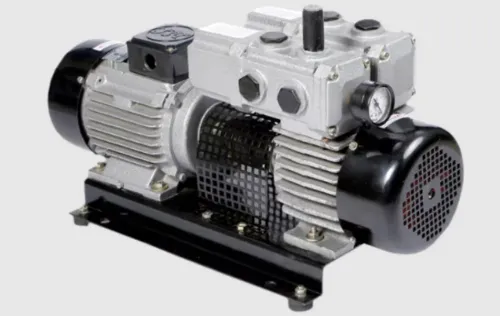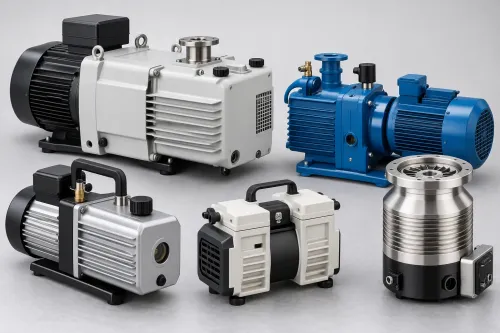
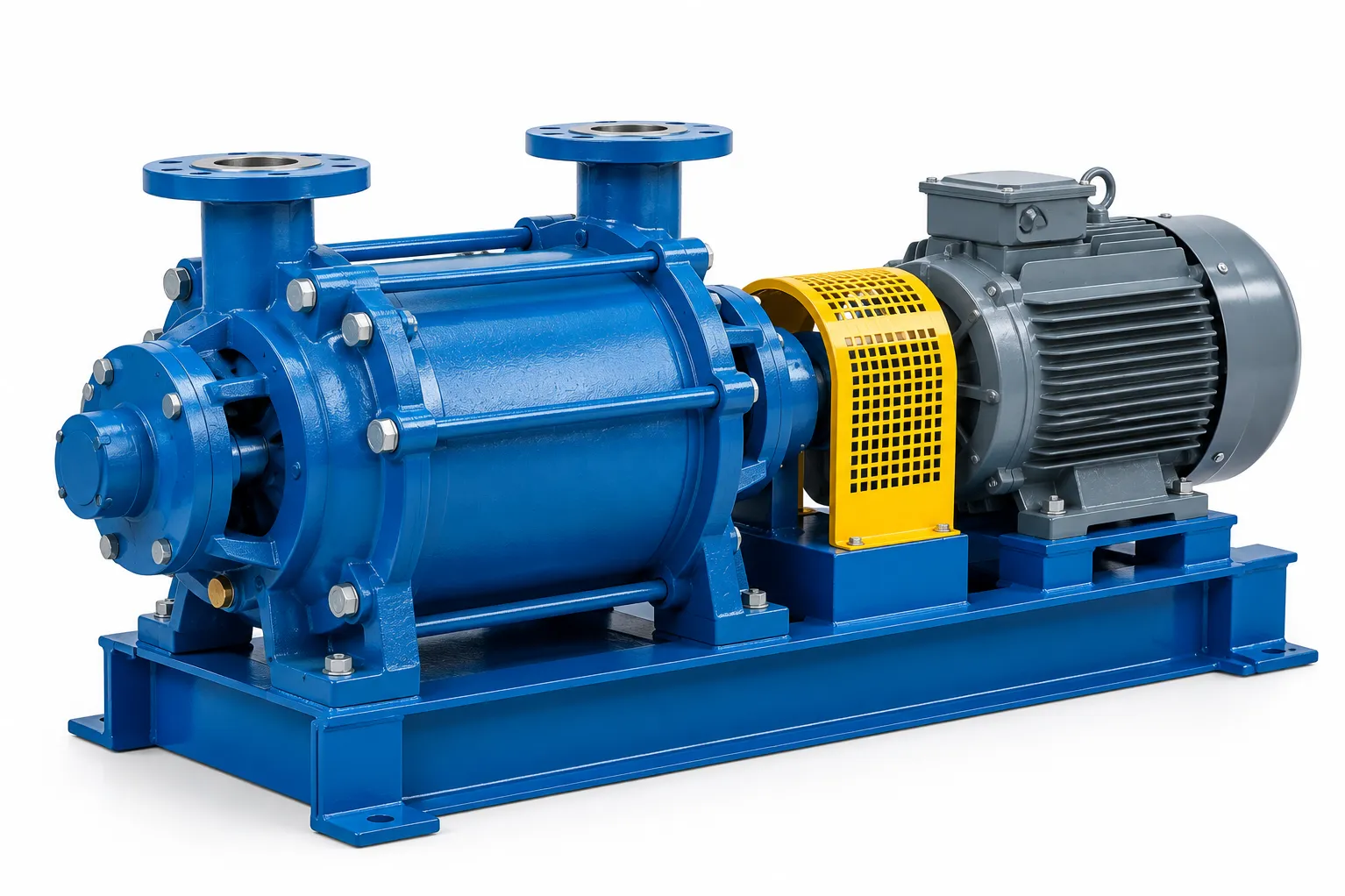
Processes containing moisture, condensable vapours, or small quantities of liquid can be difficult for vacuum equipment designed primarily for clean, dry gas. Water ring vacuum pumps offer a useful solution because their operating principle uses a rotating liquid ring to create compression chambers.
The service liquid is commonly water, although another compatible liquid may be selected for particular processes. These pumps are used in chemical processing, food production, paper, pharmaceuticals, power-related operations, evaporation, filtration, and other heavy industrial duties.
How the Liquid Ring Creates Vacuum
An impeller rotates eccentrically inside the pump casing. Centrifugal force forms the service liquid into a ring around the casing. The space between the impeller blades and liquid ring expands on the inlet side, drawing in gas. It then decreases toward the discharge side, compressing and releasing the gas.
Because the compression area contains liquid, the pump can tolerate wet gas and certain liquid carryover better than many dry-running technologies. This does not mean unlimited liquid can enter the pump, and process-specific protection may still be required.
Applications Where the Design Is Valuable
Water ring vacuum pumps can be considered for:
- Vacuum filtration
- Moisture-rich gas extraction
- Evaporation and concentration
- Vacuum drying
- Condenser evacuation
- Pulp and paper processes
- Priming and dewatering
- Degassing
- Solvent or vapour handling with suitable controls
- Process duties involving condensable gases
Industrial plants in Faridabad should evaluate gas composition and environmental requirements before treating water-ring technology as a standard utility pump.
Service Liquid Temperature Matters
The achievable vacuum depends partly on the vapour pressure of the service liquid. As water temperature rises, its vapour pressure increases, which can limit vacuum performance.
During Haryana’s warmer months, recirculated water may become hotter than expected. A system that performs adequately in winter could lose capacity or vacuum depth during summer if cooling is insufficient.
Engineers should review the incoming service-water temperature, expected heat load, recirculation method, heat exchanger capacity, and permissible operating vacuum.
Once-Through and Recirculated Arrangements
A once-through arrangement supplies fresh liquid and discharges it after passing through the pump. It is simple but may consume substantial water and create an effluent-handling requirement.
A partial or total recirculation system can reduce water consumption. It may include a separator tank, heat exchanger, circulation pump, controls, and provision for make-up liquid.
The appropriate arrangement depends on water availability, contamination, process vapours, discharge regulations, and operating cost.
Material Compatibility Cannot Be Assumed
The pump casing, impeller, seals, piping, and accessories must be compatible with the process gas and service liquid. Corrosive compounds or contaminated water can damage unsuitable materials.
Process evaluation should identify:
- Gas and vapour composition
- Expected concentration
- Operating temperature
- Solids or crystals
- Potential chemical reactions
- Required seal materials
- Treatment needed before discharge
Where solvents or hazardous vapours are involved, safety and environmental specialists should participate in the system design.
Avoid Common Performance Problems
Reduced vacuum may result from hot service liquid, inadequate liquid flow, air leakage, blocked piping, internal scaling, worn components, or incorrect rotational direction. Excessive liquid flow can also increase power consumption without improving performance.
Instrumentation for vacuum, service-liquid temperature, flow, and motor current makes troubleshooting more systematic.
Water ring vacuum pumps are valuable because they address conditions that can challenge other pump types, but they must be engineered as a complete system. For plants in Faridabad and across Haryana, attention to water temperature, recirculation, corrosion, utilities, and effluent management is essential to achieving dependable wet-process performance.
Keywords