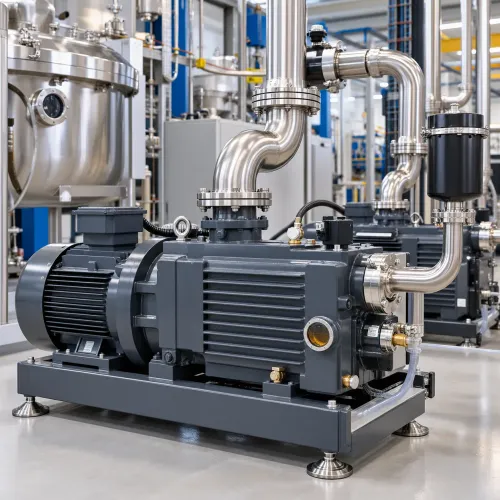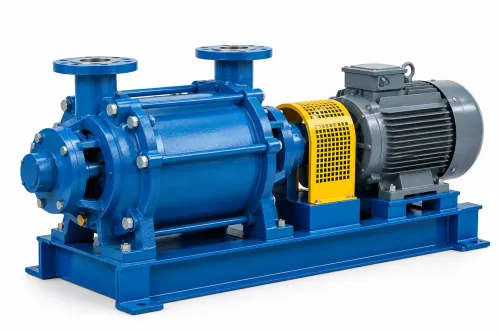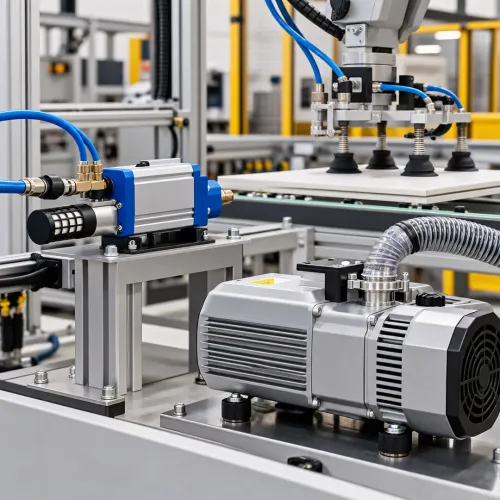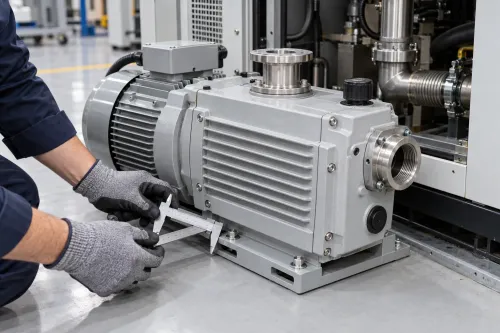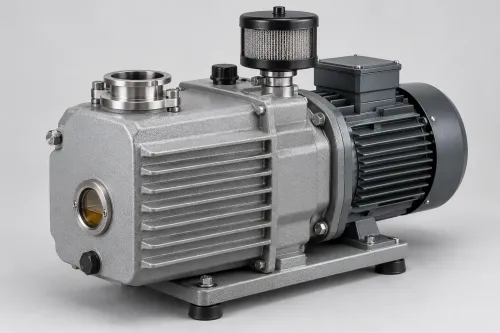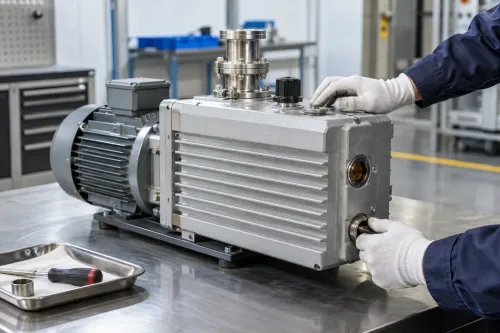
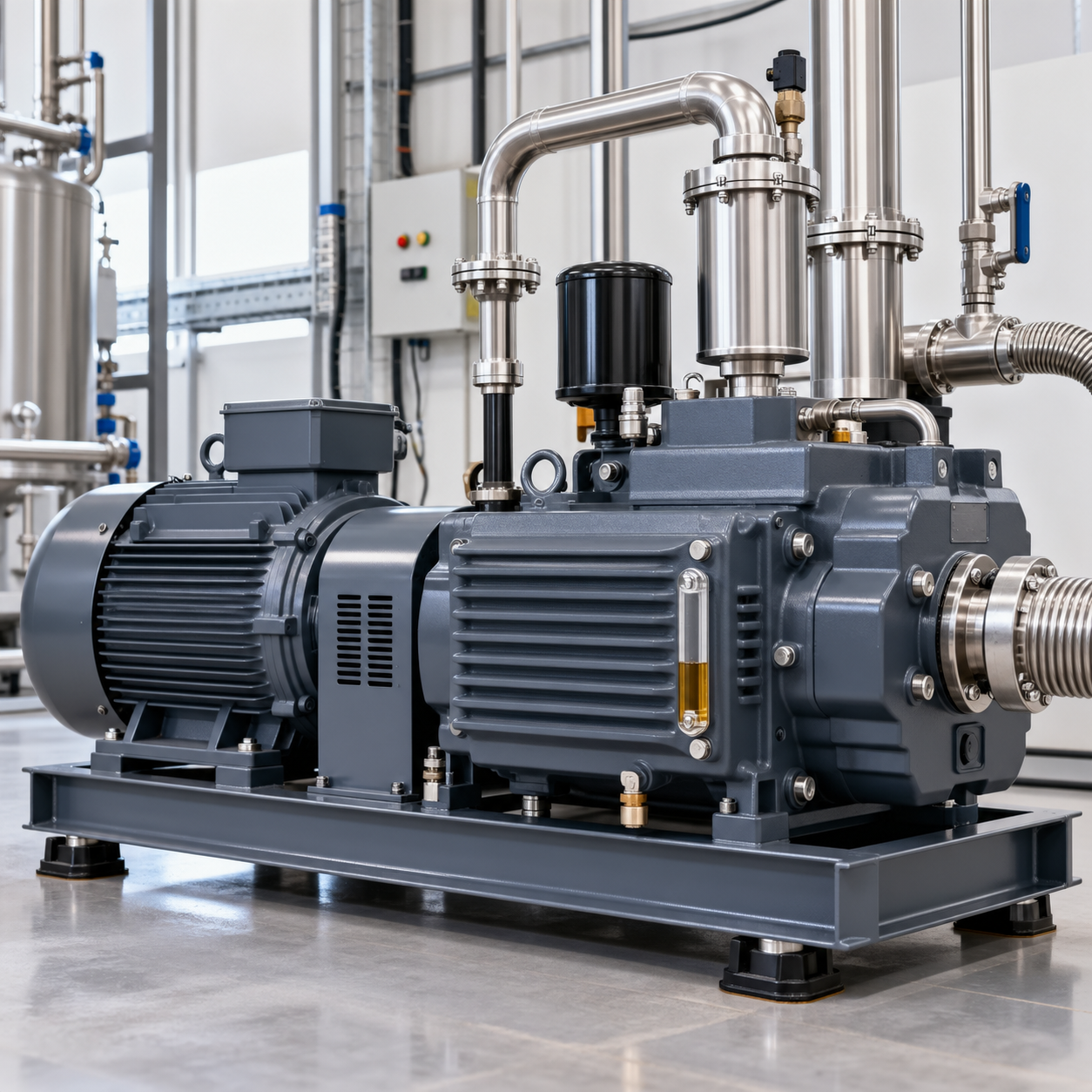
Some industrial machines require both vacuum and positive pressure. Vacuum may hold, lift, feed, or position a component, while pressure may separate sheets, discharge material, aerate a surface, or support another stage of the cycle.
Oil-lubricated vacuum pressure pumps combine these functions in one equipment arrangement. They can simplify machine design, but only when both operating requirements fall within the pump’s permitted range.
Define Vacuum and Pressure Separately
A common buying mistake is to specify the vacuum requirement while leaving the pressure side undefined. Both sides influence pump loading and operating temperature.
Machine builders should document:
- Required vacuum level
- Vacuum flow at the operating point
- Required discharge pressure
- Pressure-side flow
- Whether both functions operate simultaneously
- Cycle duration
- Leakage on each side
- Permitted air temperature
- Daily operating hours
The maximum values should not automatically become the normal duty point. A pump operating continuously near its limits may run hotter and require more frequent maintenance.
Typical Industrial Uses
Dual-function pumps may be applied in printing, paper handling, packaging, woodworking, pneumatic conveying assistance, machine automation, and specialised OEM systems.
In sheet-fed equipment, vacuum can pick up a sheet while pressure air helps separate adjacent sheets. In packaging machinery, suction may position a product while pressure supports release or transfer.
The exact requirement varies with product weight, surface finish, porosity, cycle speed, and suction-cup design.
Check Air Quality and Filtration
Oil-lubricated pumps should receive air that is compatible with their internal construction. Fine dust, paper fibres, wood particles, or process vapour can contaminate oil and increase wear.
Filters should be selected for both protection and acceptable pressure loss. An undersized filter can restrict airflow and reduce machine speed, while inadequate filtration exposes the pump to contamination.
Where there is a risk of liquid entering the inlet, a suitable separator or trap should be considered.
Evaluate Heat at the Real Duty Point
Creating vacuum and pressure simultaneously can impose a demanding thermal load. Installation inside a machine cabinet requires adequate ventilation and clearance around cooling surfaces.
Buyers in Faridabad should account for high summer ambient temperatures. The pump’s discharged hot air should not circulate back into the enclosure.
Motor current and pump temperature during a full production cycle provide more useful evidence than a brief no-load test.
Review Controls and Safety
Vacuum and pressure lines should be identified clearly to avoid incorrect connection. Relief devices, non-return valves, gauges, filters, and control valves should be selected according to the machine design.
If loss of vacuum could allow a suspended load to fall, the system may need vacuum switches, alarms, reservoirs, non-return valves, or mechanical retention. Pump selection alone does not replace machine safety engineering.
Look Beyond the Purchase Price
A buying comparison should include oil changes, filters, separator elements, wear parts, energy consumption, service access, and replacement lead times.
For OEM manufacturers, consistency across future production is also important. The supplier should be able to provide stable specifications, dimensional information, and technical documentation for machine integration.
Kalbro Vacumatics can be evaluated as a local source of oil-lubricated vacuum pressure pumps for industrial equipment in Faridabad. Before requesting a quotation, buyers should prepare a duty sheet covering both vacuum and pressure requirements. That single step makes proposals easier to compare and helps prevent oversizing, overheating, insufficient flow, and costly machine modifications after installation.
Keywords