Not every industrial process is comfortable with oil being present inside the pumping mechanism. Certain manufacturing environments place greater importance on clean operation, simplified process handling, or reducing the possibility of oil-related contamination. This is where dry vacuum pumps become particularly relevant.
For machine builders, plant engineers, and manufacturers in Faridabad, understanding where dry technology provides practical value is more useful than assuming that it is automatically the best option for every application.
What Makes a Vacuum Pump Dry?
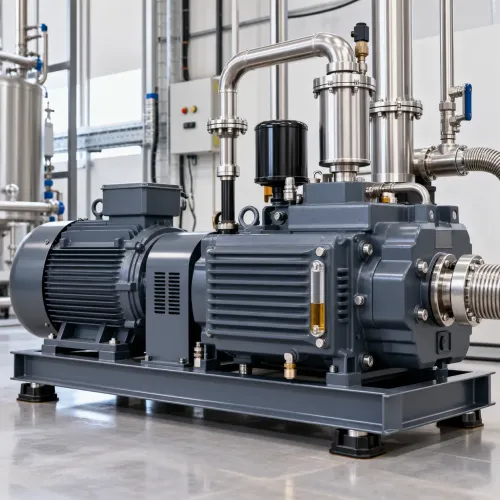
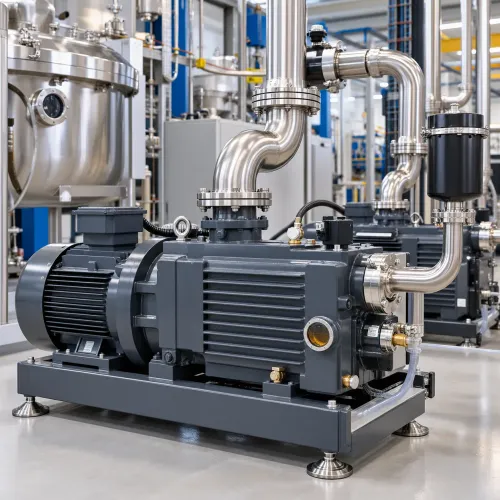
A dry vacuum pump is designed to generate vacuum without using lubricating oil in the pumping chamber.
This distinction matters because oil-lubricated vacuum pumps and dry pumps have different operating characteristics, maintenance requirements, and application suitability.
The term 'dry' should therefore be understood in relation to the pumping mechanism rather than interpreted as meaning that every component of an entire machine is maintenance-free.
Why Do Industries Consider Dry Vacuum Technology?
One important reason is process cleanliness.
Where contamination from pump oil would be undesirable, keeping the pumping chamber oil-free can offer a practical advantage. Depending on the process and pump design, dry operation may also reduce some oil-related maintenance activities.
Typical considerations include:
- Cleaner process requirements
- Avoidance of oil in the pumping chamber
- Reduced dependence on pump oil management
- Integration into OEM machinery
- Continuous industrial production requirements
- Simplification of certain maintenance routines
These benefits must still be evaluated against the actual process conditions.
Applications Where Dry Pumps May Be Considered
Dry vacuum technology can be found in a variety of industrial environments.
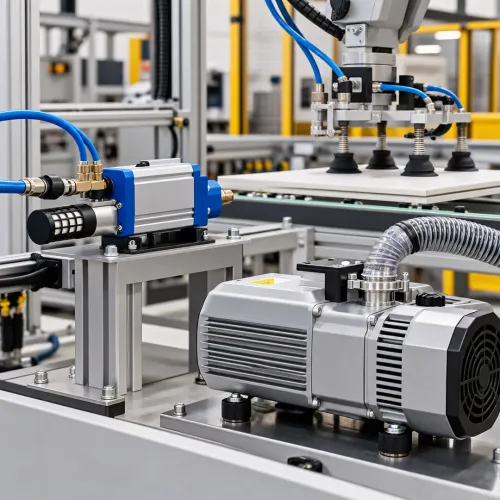
Machine builders may use it in automated equipment where vacuum performs gripping, holding, or material movement functions.
Printing and paper-handling machinery can use vacuum for sheet movement and positioning. Packaging machines may depend on vacuum during specific stages of their operating cycle.
Other possible areas include woodworking equipment, industrial automation, material handling, and specialised process machinery.
The correct technology depends on the vacuum level, airflow requirement, contaminants, temperature, and operating duration involved.
Dry Does Not Mean Maintenance Free
This is an important distinction for maintenance managers.
A dry pump removes one particular maintenance consideration the use of lubricating oil in the pumping chamber but other components still require attention.
Depending on the design and installation, maintenance teams may need to monitor:
- Inlet filters
- Bearings
- Drive components
- Cooling arrangements
- Piping connections
- Vacuum leakage
- Dust accumulation
- Operating temperature
Preventive inspection remains essential.
Consider the Incoming Air
One of the biggest selection mistakes is looking only at the desired vacuum level.
What enters the pump can be equally important.
Is the incoming gas clean and dry? Does the process generate fine powder? Is moisture present? Are vapours likely to condense? Could particles enter the inlet?
A pump that performs well with clean air may require additional protection when installed on a dusty production process.
Proper filtration or process separation can therefore be as important as the pump itself.
Think About the Actual Duty Cycle
A machine that runs vacuum for several seconds every few minutes creates a different operating requirement from equipment that runs continuously across multiple shifts.
Procurement teams should define whether the application involves:
- Intermittent operation
- Frequent start-stop cycles
- Continuous operation
- Variable vacuum demand
- Seasonal production
- Round-the-clock manufacturing
This information helps engineers assess pump sizing and system configuration more accurately.
Local Operating Conditions Matter Too
Faridabad is one of Haryana's established manufacturing centres, with factories ranging from engineering and automotive supply operations to packaging, fabrication, machinery, and general manufacturing.
Industrial environments can expose equipment to dust, heat, and demanding production schedules. A vacuum pump therefore needs to be considered as part of the plant environment rather than solely according to catalogue specifications.
Adequate ventilation and easy maintenance access should be planned during installation.
When Is a Dry Pump Worth Evaluating?
A dry vacuum pump deserves consideration when oil-free pumping chamber operation provides a meaningful process or maintenance advantage.
That does not mean replacing an existing oil-lubricated pump purely because dry technology sounds newer. The engineering question is whether the dry pump's characteristics match the application better.
Kalbro Vacumatics manufactures industrial vacuum equipment for applications where these operating variables need to be assessed together.
For manufacturers and OEMs in Faridabad and across Haryana, the sensible approach is to define the process first. Required vacuum, airflow, operating hours, incoming gas conditions, installation environment, and maintenance expectations should all be considered before the pump technology is finalised.
Keywords