Factories can generate vacuum in several ways, and an electric motor-driven pump is not always the only option. Compressed air driven vacuum pumps can be useful in applications where compressed air is already available and the vacuum demand is localised, intermittent, or closely integrated with pneumatic automation.
The right choice depends on how the system will actually operate.
How Compressed Air Driven Vacuum Generation Works
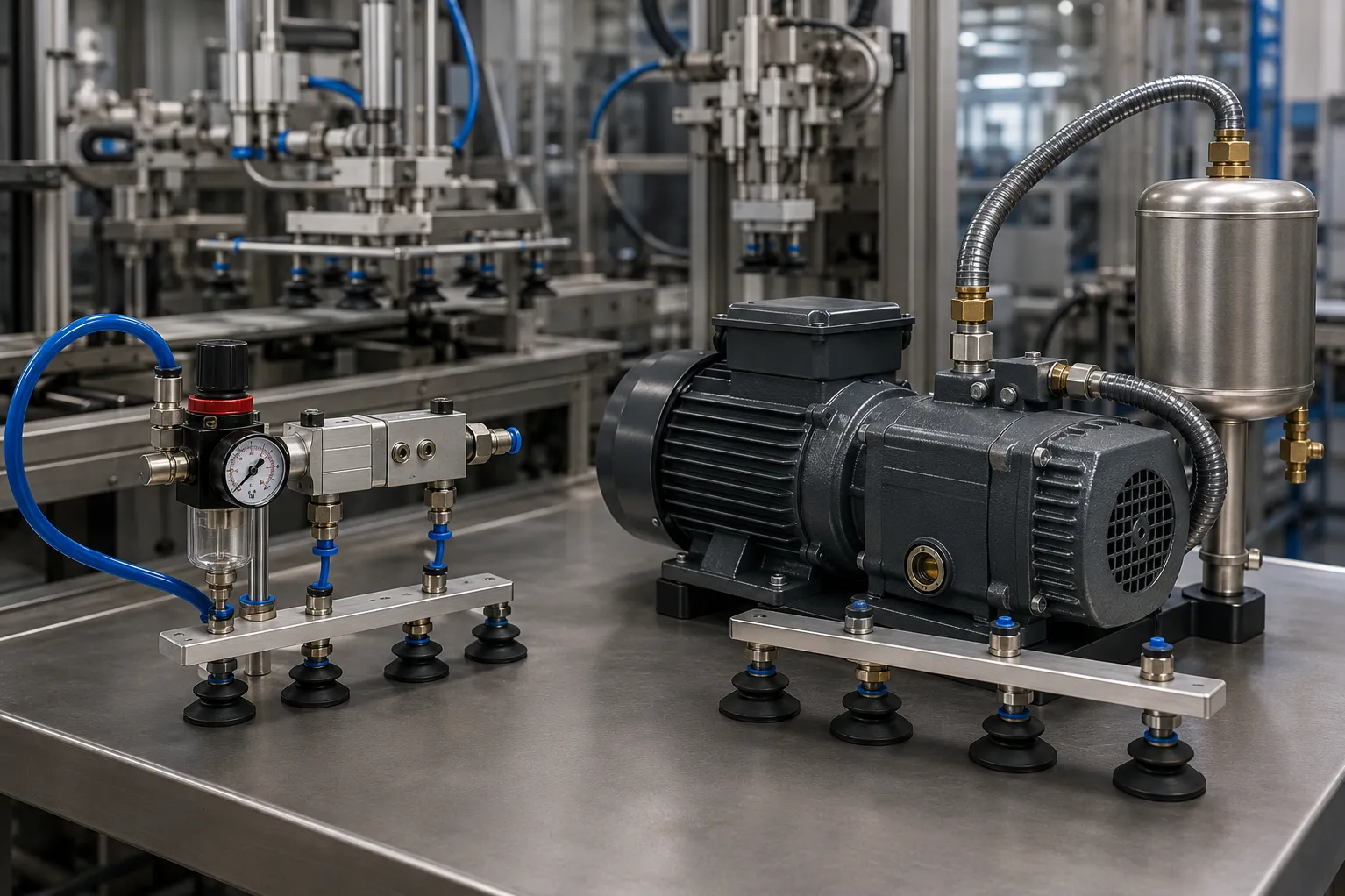
Compressed air driven systems use compressed air as the energy source for producing vacuum rather than relying on a dedicated electric motor at the vacuum generation point.
This can make the arrangement compact and convenient for certain machine-building and automation applications.
However, compressed air itself requires energy to produce. Evaluating only the absence of a local electric motor can therefore give an incomplete picture of operating cost.
When Compressed Air Driven Vacuum Makes Sense
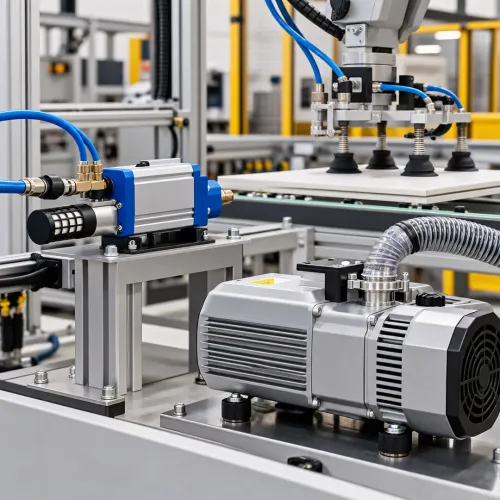
These systems can be particularly useful where vacuum is required close to the point of use.
Examples may include:
- Pick-and-place equipment
- Robotic handling
- Suction cup systems
- Packaging machinery
- Assembly automation
- Component transfer
- Intermittent gripping
- Compact OEM machines
They can also simplify integration where a machine already has a pneumatic supply.
When a Motor Driven Pump May Be More Suitable
A dedicated vacuum pump may be more appropriate when vacuum demand is continuous, relatively large, or shared across several process points.
Centralised vacuum generation can also be considered where multiple machines require vacuum and the facility wants to manage generation from one system.
The correct choice depends on actual demand rather than a blanket rule.
Compare Air Consumption With Vacuum Demand
One of the most important calculations for compressed air driven equipment is compressed air consumption.
Compressed air is an industrial utility with a significant energy cost. Leaks and inefficient use can make a pneumatic system expensive to operate.
Before choosing a solution, estimate:
- Vacuum demand per cycle
- Number of cycles per minute
- Required vacuum level
- Compressed air consumption
- Daily operating hours
- Number of vacuum points
A small intermittent application may produce a very different cost picture from dozens of continuously operating vacuum generators.
Response Time Can Matter
Point-of-use vacuum generation can reduce the distance between the vacuum source and suction device.
For rapid automation cycles, this may provide practical system advantages.
However, tubing dimensions, suction cup volume, leakage, and control design also influence response.
Engineers should assess the entire pneumatic circuit rather than focusing only on the vacuum generator.
Think About Noise and Exhaust
Compressed air equipment creates exhaust flow and can generate noise.
Machine builders should account for the installation environment, particularly when equipment operates close to personnel.
Suitable exhaust arrangements and noise-control measures may be relevant depending on the application.
Centralised or Decentralised Vacuum?
This is another useful comparison.
A decentralised system generates vacuum close to individual machines or suction points. It can provide independent control and shorter vacuum lines.
A centralised system uses one or more larger pumps to serve multiple demand points.
Neither approach is universally better.
Factories with highly variable production may value independent control, while facilities with stable, continuous vacuum requirements may find centralised generation worth evaluating.
Calculate Lifecycle Cost
The initial equipment price is only one part of the decision.
Compare:
- Capital cost
- Compressed air energy requirement
- Electrical energy requirement
- Maintenance
- Filters and consumables
- Production duty
- Expected utilisation
- Installation complexity
For high-use equipment, relatively small efficiency differences can become significant over years of operation.
Application Decisions in Faridabad
Faridabad's engineering and manufacturing sector includes automotive component suppliers, machine builders, packaging operations, fabrication businesses, and automation users. Many already operate extensive compressed air networks.
This can make compressed air driven vacuum attractive for particular points of use, but existing compressed air availability should not automatically determine the choice.
Kalbro Vacumatics supplies industrial vacuum equipment for different process requirements. For buyers in Faridabad, Haryana, a useful evaluation starts with the actual vacuum duty and then compares the energy source, operating frequency, control requirements, and lifecycle cost.
The best solution is the one that provides the required vacuum reliably without using more energy or infrastructure than the process genuinely needs.
Keywords