When an existing Becker vacuum pump reaches the point where repair, replacement, or an alternative solution is being considered, procurement teams face a common challenge: how do you evaluate options without disrupting machine performance?
Choosing purely by motor rating or physical appearance can be risky. Vacuum equipment should be matched according to operating requirements and system conditions.
Start With the Existing Application
Before evaluating any replacement, document what the current pump actually does.
Record the machine type, operating vacuum, expected airflow, daily running hours, and process conditions.
It is also worth identifying why replacement is being considered.
Is the pump no longer achieving sufficient vacuum? Are maintenance costs increasing? Is the existing model difficult to support? Has production demand changed?
The reason behind replacement can influence the appropriate solution.
Do Not Compare Motor Power Alone
Two vacuum pumps with similar motor ratings can have different pumping characteristics.
Important parameters may include:
- Pumping capacity
- Operating vacuum range
- Ultimate vacuum
- Motor specification
- Connection size
- Cooling requirements
- Noise characteristics
- Physical dimensions
- Duty suitability
The application operating point should remain the priority.
A pump with an impressive ultimate vacuum specification may still be unsuitable if it cannot deliver the required capacity where the machine normally operates.
Check Installation Dimensions
Replacement projects often have space limitations.
Existing machines may have fixed mounting arrangements, restricted pipe routing, or limited ventilation clearance.
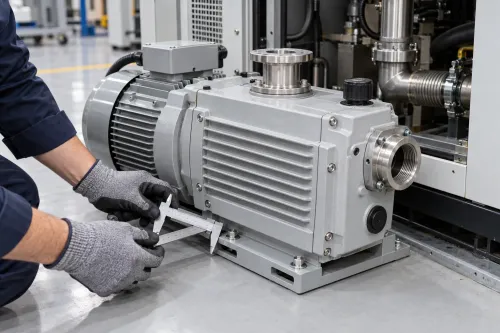
Measure the available installation area rather than assuming another pump will fit because its nominal capacity is similar.
Also check inlet and outlet positions. Significant piping modifications can increase installation time and cost.
Understand Process Contamination
If the previous pump has experienced repeated failures, replacement alone may not solve the problem.
Investigate what the pump is handling.
Dust, moisture, process vapours, fibres, or particles can affect reliability. Suitable inlet protection or system modifications may be needed before a new pump is installed.
A history of frequent filter blockage is particularly useful information because it may reveal process conditions that were not considered in the original machine design.
Evaluate the Real Duty Cycle
A pump installed on a machine that runs occasionally has different requirements from one operating continuously across two or three shifts.
Provide suppliers with realistic operating information.
Useful details include:
- Hours per shift
- Number of shifts
- Start-stop frequency
- Normal vacuum level
- Peak vacuum demand
- Ambient conditions
- Seasonal changes in production
This creates a more meaningful basis for comparison.
Consider Maintenance Accessibility
A replacement that technically fits but makes routine servicing difficult can create long-term inconvenience.
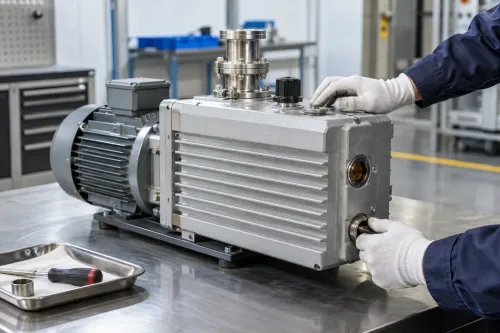
Filters, oil-related service points where applicable, and other maintenance components should be reasonably accessible.
Plant maintenance teams should also understand recommended inspection and service requirements before approving a replacement.
Look Beyond Purchase Price
Procurement decisions naturally involve price, but industrial equipment costs continue after installation.
Consider the broader ownership picture:
Energy consumption: Oversized equipment may consume unnecessary power.
Consumables: Pump technology determines what routine consumables may be required.
Maintenance: Accessibility and servicing frequency influence labour requirements.
Downtime: Equipment that is difficult to service can increase production disruption.
System modification: Changes to piping, electrical connections, or mounting can add to replacement costs.
Faridabad Plants Need Application-Based Selection
Manufacturing facilities across Faridabad and Haryana frequently operate imported, domestic, and OEM-built machinery containing vacuum equipment from different manufacturers.
When an existing Becker pump or another installed vacuum unit requires evaluation, documenting the machine requirement allows alternatives to be assessed on engineering criteria rather than brand name alone.
Kalbro Vacumatics works in industrial vacuum pump manufacturing and can be considered when businesses are evaluating vacuum equipment for existing machinery or new installations.
The most useful information to have ready is the existing pump identification, application, required vacuum, capacity, operating hours, and process conditions.
A replacement decision based on these factors has a much better chance of maintaining machine performance while avoiding unnecessary oversizing or system modifications.
Keywords