A KB 530 is identified by more than a model number: its useful performance depends on the test conditions, operating point, motor configuration and installation. By the end, you can explain how the pump works, interpret its vacuum, pressure and flow figures, match it to equipment, and prepare accurate export documentation.
Key takeaways
- Use the KB 530 for vacuum and low-pressure air movement in sealed equipment.
- Treat 30 m3/hr as rated displacement, not guaranteed flow at every pressure.
- Confirm whether the 0.8 bar figure means gauge pressure, absolute pressure, or differential pressure.
- Give exporters voltage, frequency, rotation, ports, duty cycle, and performance conditions.
How a KB 530 Creates Vacuum and Pressure
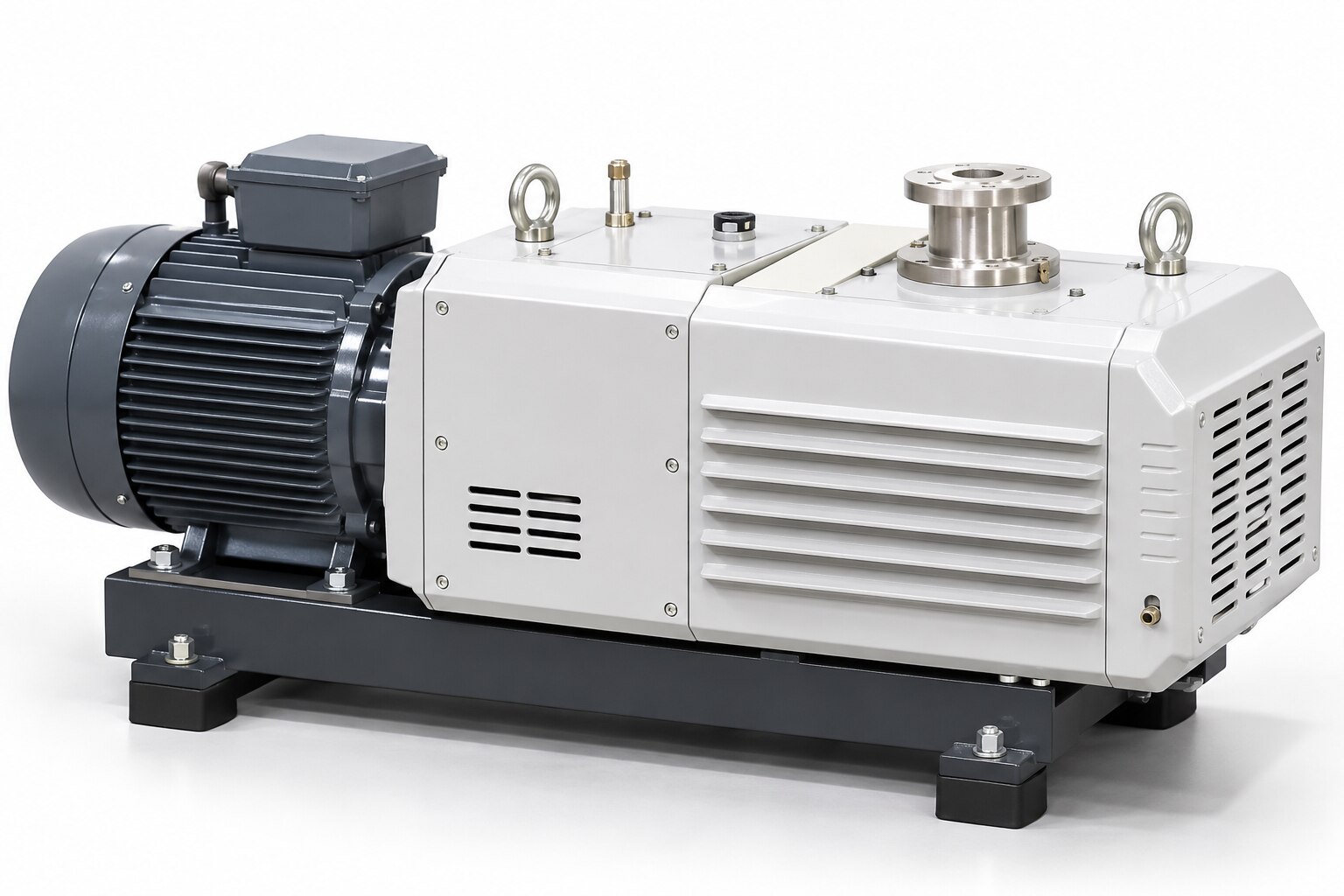
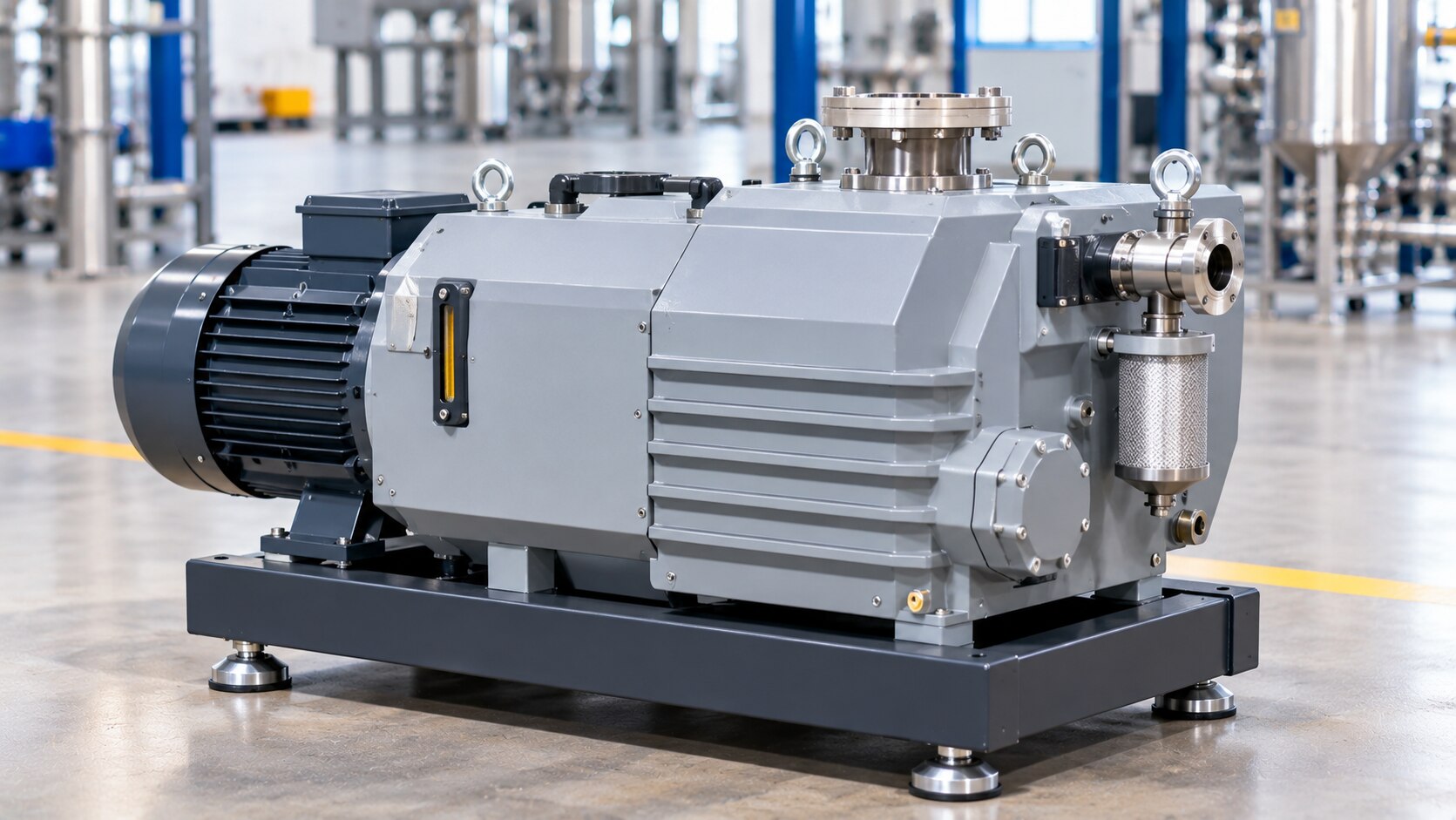
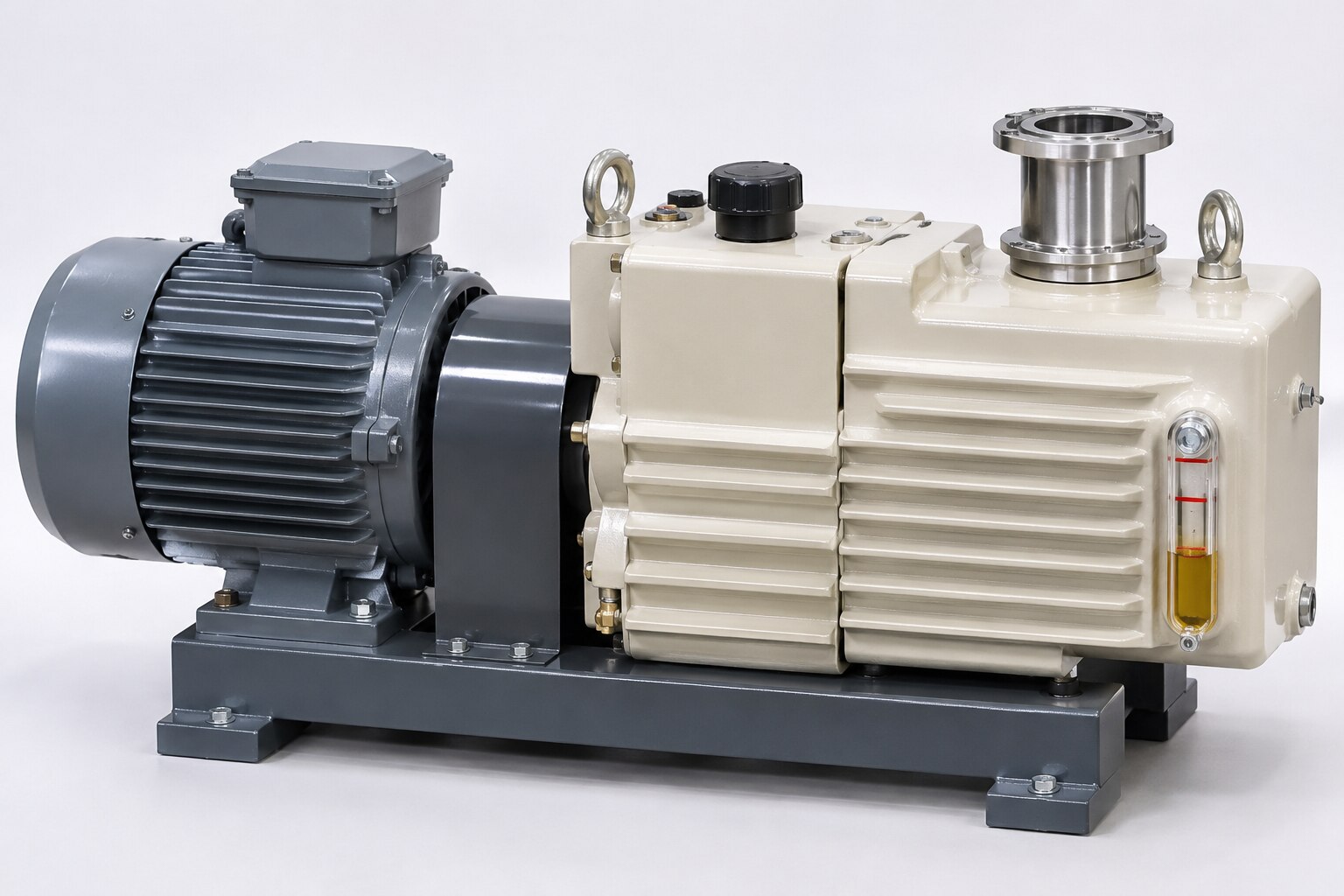
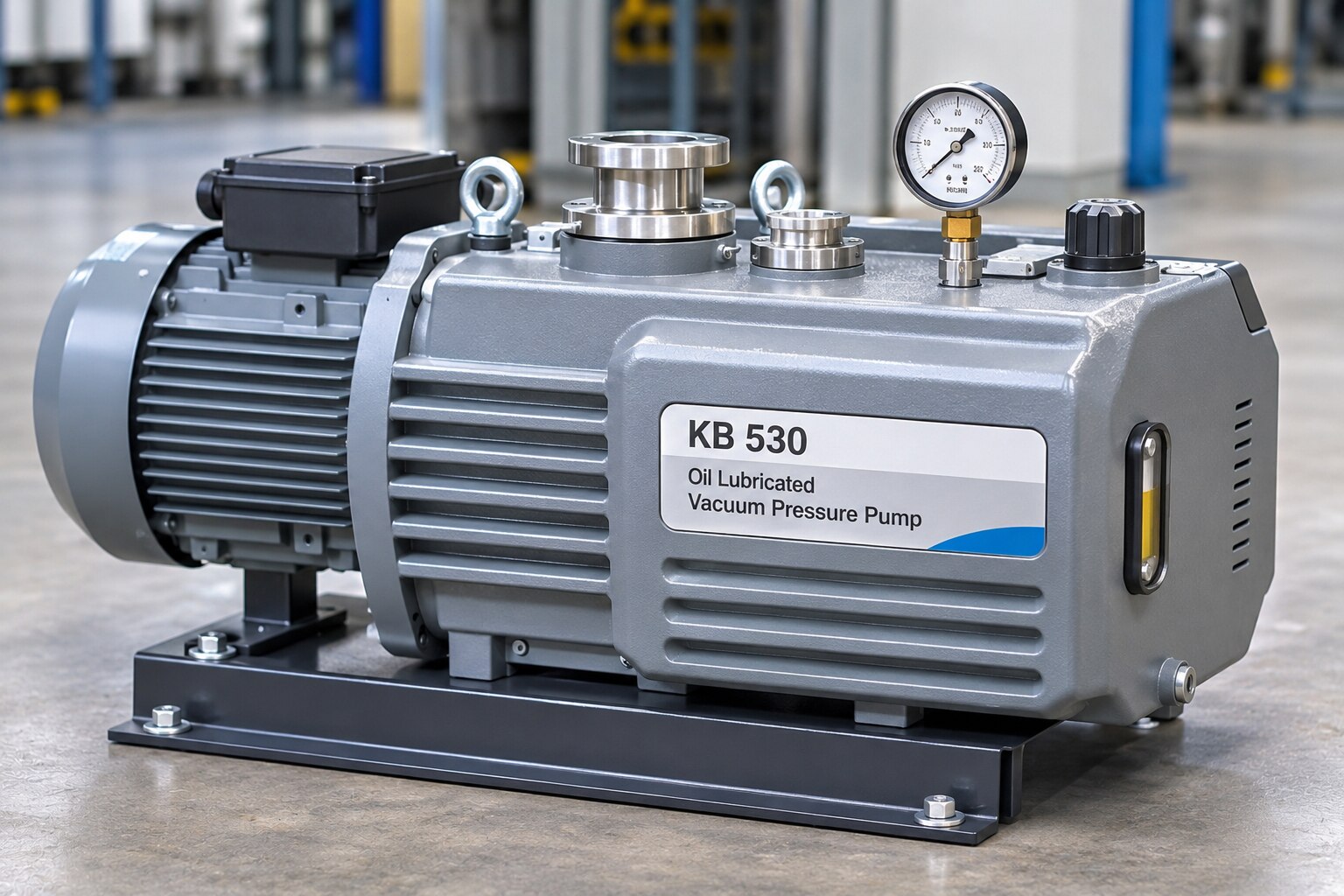
An oil-lubricated KB 530 is a rotary-vane vacuum pressure pump: one rotating assembly handles two operating modes. The KB 530 vacuum pressure pump uses oil to seal the spaces between sliding vanes and the casing, reducing internal leakage while the rotor turns.
On the vacuum side, the inlet connects to the vessel or process line. As each vane moves away from the inlet, its chamber expands and draws gas out; the chamber then contracts and carries that gas to the exhaust. The vessel falls below atmospheric pressure, creating vacuum.
On the pressure side, the inlet takes atmospheric or process air, and the exhaust becomes the pressurised outlet. The shrinking vane chambers compress and discharge the air for blow-off, agitation or conveying.
Reversing the connection is not the same as running both modes together: vacuum and positive pressure have separate limits, and the pump cannot normally deliver its maximum vacuum and maximum pressure simultaneously.
Treat a stated 0.8 bar rating as incomplete until its reference is confirmed. It could mean 0.8 bar vacuum relative to atmosphere, about 200 mbar absolute at sea-level reference, or a pressure-side gauge rating.
Ask for:
- Separate vacuum and pressure curves
- Absolute or gauge reference for each rating
- Continuous-duty pressure limit and discharge temperature
- Relief-valve arrangement and test conditions
What the 30 m3/hr and 0.8 Bar Ratings Actually Mean
A stated flow of 30 m3/hr is a capacity figure, not proof that the pump delivers 30 m3/hr at every vacuum or pressure. It may describe nominal free-air displacement at a specified speed, close to 500 L/min, while leakage, valve losses, oil condition, gas temperature and system resistance reduce usable flow.
The 0.8 bar vacuum figure needs its reference. If it means 0.8 bar vacuum gauge, the inlet reaches approximately 200 mbar absolute against atmospheric pressure. If it means 0.8 bar absolute, the vacuum is much deeper. Do not treat either interpretation as confirmed until the datasheet states gauge or absolute pressure and gives test conditions.
The 0.8 bar pressure figure has the same problem. It may mean 0.8 bar gauge at the outlet, but the manufacturer must state whether that pressure is continuous-duty capability or applies only at a specified flow, speed and gas temperature. Maximum vacuum and maximum positive pressure are separate operating limits, not simultaneous performance claims.
For kb 530 oil lubricated pump applications, request:
- A pumping-speed curve showing delivered flow against inlet pressure.
- A power curve showing motor demand at each operating point.
- The ultimate-vacuum test conditions, including warm-up time, oil condition and sealed-inlet method.
- The outlet-pressure limit, reference pressure and permitted continuous flow.
Design around the curve at your working pressure, not the headline number. A pump reaching ultimate vacuum with a sealed inlet can lose that vacuum quickly under continuous gas load, especially when wet or dusty gas contaminates the oil.
What the 2 hp and 1.5 kW Motor Specification Tells You
A 2 hp motor is rated at about 1.5 kW of electrical input; it does not mean the pump delivers 1.5 kW of useful vacuum or pressure work. Confirm the motor’s nominal voltage, phase, frequency, rated speed, efficiency class, enclosure or IP rating, and regional certification before ordering.
- Match the supply: state 50 or 60 Hz, single- or three-phase operation, and the exact voltage range. A 50 Hz motor on a 60 Hz supply can run at a different speed, while the wrong voltage can cause overheating or failure.
- Request rated revolutions per minute at the specified frequency. Pump displacement and delivered flow depend on rotational speed, so a model number alone does not prove capacity.
- Ask for starting current, locked-rotor current, and the recommended breaker, contactor, soft starter, or variable-frequency drive. A motor that runs within the supply rating can still trip protection during startup.
- Confirm whether the stated 2 hp applies to continuous duty and whether the starter supports the motor’s full-load current.
| Motor input power | Pump output |
|---|---|
| Electrical power consumed by the motor | Vacuum or pressure work delivered to the gas |
| Rated near 1.5 kW, before motor and transmission losses | Depends on inlet pressure, gas load, leakage, oil condition, temperature, and speed |
| Used to size electrical supply and protection | Used to assess actual pumping speed and operating performance |
Ask for a pump curve showing pumping speed and motor power at your working pressure, not only the 2 hp label.
Where the Pump Fits in Real Equipment
Vacuum-side connections serve sealed chambers, packaging machines, vacuum lifting equipment, degassing units and filtration systems. Pressure-side connections serve pneumatic conveying, air agitation, blow-off and low-pressure aeration. These are separate operating modes: maximum vacuum and maximum positive pressure are not available at the same time.
| Connection | Equipment it serves | Checks before selection |
|---|---|---|
| Vacuum side | Chambers, packaging lines, lifters, filters and degassing equipment | Pumping speed at the working vacuum, inlet filtration and vapour protection |
| Pressure side | Conveying lines, aeration tanks, agitation systems and blow-off stations | Continuous pressure rating, discharge temperature, relief valve and duty approval |
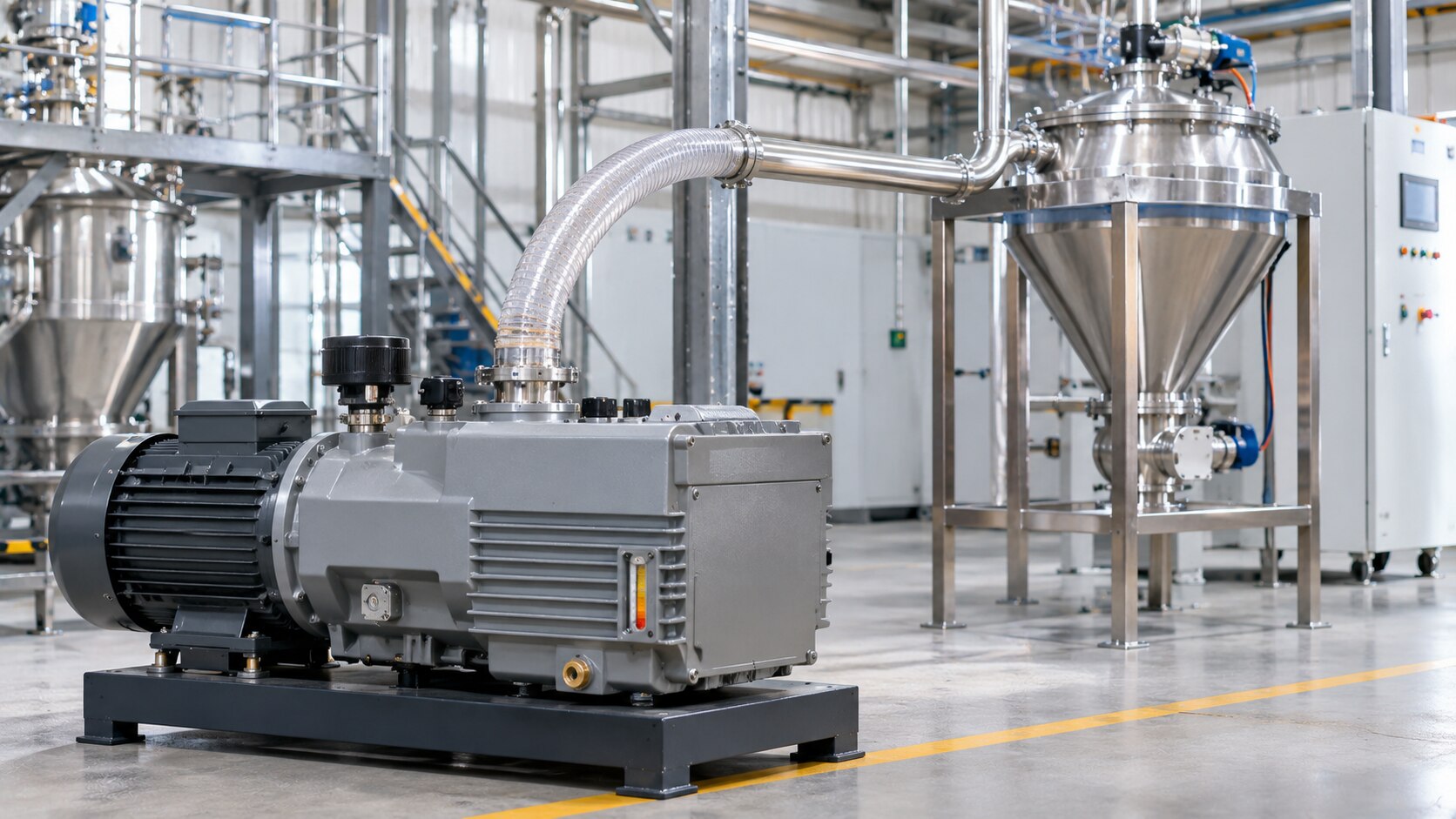
Typical KB 530 vacuum pressure pump uses depend on the gas entering the inlet and the duty cycle. Typical KB 530 oil lubricated pump applications suit clean, dry air where oil vapour and carryover cannot reach the product.
Oil seals the rotary vanes and limits wear, but contaminated oil quickly reduces vacuum performance. Dust needs an adequately sized inlet filter; liquid droplets need a separator and condensate drain. Condensable vapours require a gas ballast, and the exhaust needs an oil-mist separator with a return system where permitted.
Before approving continuous operation, confirm:
- The pressure-side rating applies continuously at your required flow.
- The discharge temperature stays within the manufacturer’s limit.
- A relief valve protects against blocked discharge.
- The pump curve shows speed and motor power at your actual vacuum or pressure.
- Oil inspection and replacement intervals match the dust and vapour load.
Skip these controls and the pump can overheat, stick its vanes, lose ultimate vacuum or damage its rotor and bearings.
How Exporters Should Specify a KB 530
Do not export a bare “KB 530” description. The practical answer to what is a kb 530 vacuum pressure pump for exporters is a configured oil-lubricated pump whose exact performance depends on the manufacturer’s full model code, frequency suffix, motor supply and test conditions.
Treat a kb 530 pump for export equipment as a specified machine, not a model number.
Ask the supplier to confirm:
- Full model code, vacuum and pressure limits, pump configuration, rotation direction and port sizes with thread standards.
- Pump curves for pumping speed, throughput and motor power at the actual operating pressure, aligned with ISO 21360 terminology.
- Ultimate-pressure test conditions: warm pump, clean oil, sealed inlet, gas temperature and oil grade.
- Motor voltage, phase, frequency, rated current, starting current, speed, wiring diagram and continuous-duty rating.
- Dimensional drawing, lifting points, shipping mass, oil fill quantity, service intervals, spare-parts list and test certificate.
| Document | Include |
|---|---|
| Quotation | Confirmed configuration, curves, electrical data, oil grade and stated limits |
| Commercial invoice | Exact model code, quantity, unit description, origin and agreed electrical configuration |
| Packing list | Package dimensions, gross and net mass, lifting points and contents |
| Export datasheet | Ports, rotation, dimensions, power, test conditions, service data and certificate reference |
Frequently asked questions
How does a KB 530 create vacuum and pressure?
A rotating rotor moves sliding vanes through an eccentric casing. Oil seals the vane-to-casing gaps, allowing the same assembly to create suction on one side and discharge pressure on the other.
What does the KB 530 30 m3/hr rating mean?
It indicates the pump’s rated volumetric capacity under stated test conditions. Confirm the reference speed, inlet pressure, temperature, and whether the figure is theoretical displacement or delivered flow.
What does 0.8 bar mean on a KB 530?
Confirm whether 0.8 bar describes positive gauge pressure, vacuum level, absolute pressure, or differential pressure. These measurements are not interchangeable.
Where are KB 530 vacuum pressure pumps used?
They fit equipment that needs controlled vacuum, low-pressure air, or alternating vacuum-and-pressure service, such as packaging, lifting, material handling, and process machinery. Match the pump to gas compatibility, duty cycle, pressure, and required flow.
What should exporters include when specifying a KB 530?
State the capacity, pressure and vacuum reference, motor power, voltage, frequency, phase, rotation, port sizes, oil type, mounting arrangement, duty cycle, ambient conditions, packing, and required documents.
Keywords