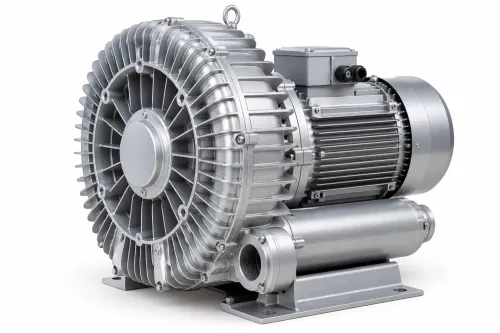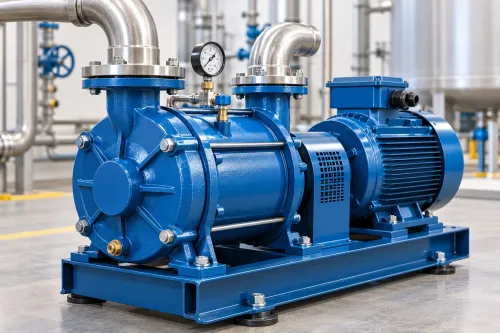
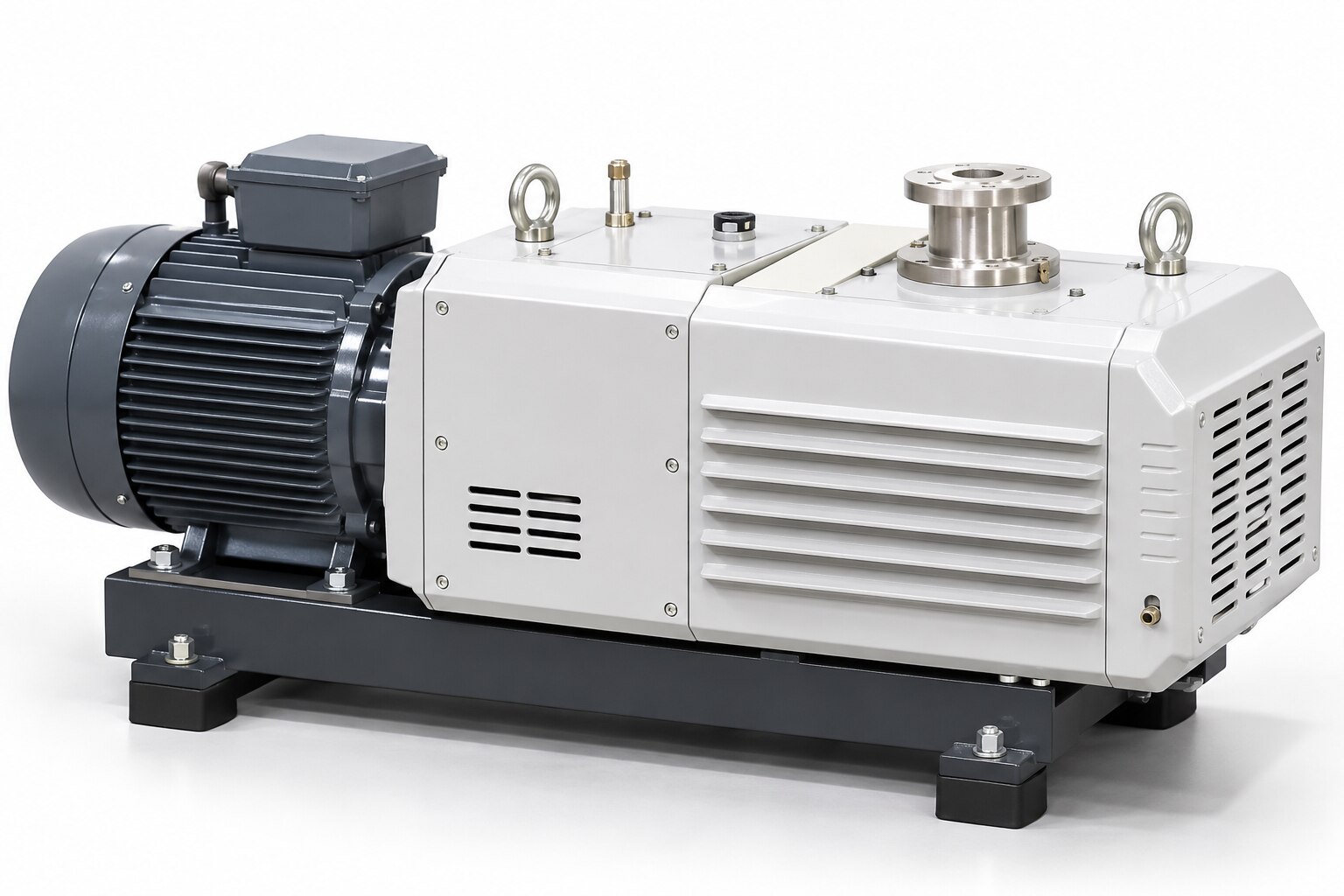
Suitability depends on more than achieving a low vacuum: you must match suction pressure, flow, gas composition, vapour load, discharge pressure, temperature and duty cycle. By the end, you can screen a dry pump against process hazards, compare alternatives and prepare a specification that accounts for Faridabad site conditions.
Key takeaways
- Map vapour load, pressure, temperature and discharge conditions before selecting a pump.
- Dry pumps need condensate control for solvents, acids and other vapours.
- Compare dry, oil-lubricated, water-ring and ejector technologies against the full process duty.
- Resolve ventilation, corrosion, utilities and hazardous-area requirements before commissioning.
Start with the Process Envelope, Not the Pump Catalogue
Suitability is determined by the process envelope, not by the pump’s advertised ultimate vacuum. For dry vacuum pressure pumps for chemical plants in faridabad, collect operating data from the vessel, piping and discharge system before comparing models.
- Record the required suction pressure, ultimate vacuum, gas flow in m³/h, gas composition and non-condensable fraction.
- State the vapour load, including solvents, acids, alkalis, chlorine-containing gases and volatile organic compounds.
- Give inlet-gas temperature, expected condensation temperature, solids or crystals, liquid carryover and any polymerising material.
- Specify continuous and peak discharge pressure separately from suction pressure, plus differential pressure during startup and upset conditions.
- Define duty cycle: hours per batch, starts per hour, continuous operation, standby requirements and annual running hours.
- Identify the hazardous-area classification and the required materials for wetted surfaces, elastomers, coatings, sensors and seals.
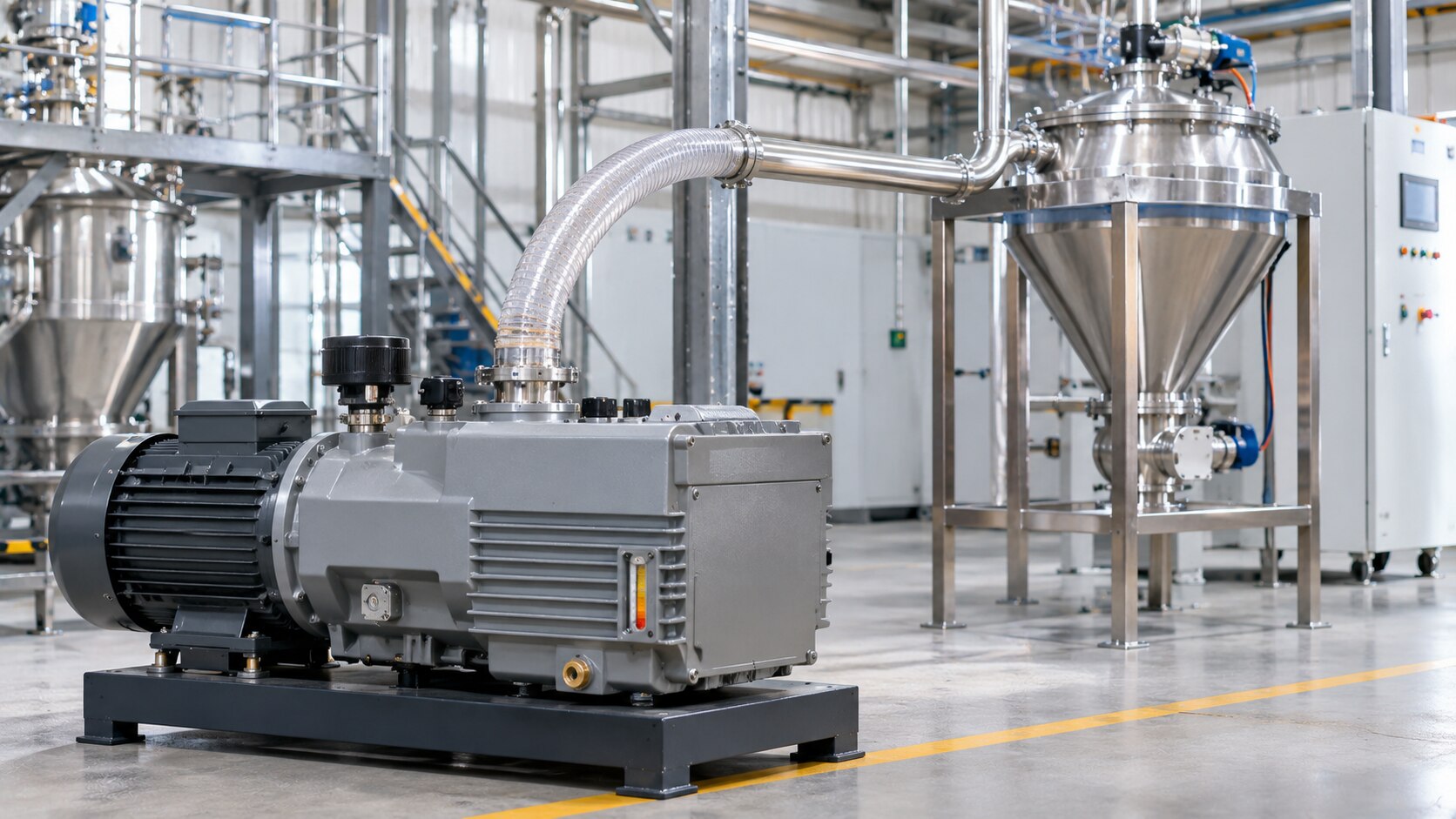
- Show the pipe length, diameter, filters, valves, condenser, knockout vessel and scrubber between the process and pump.
Require a performance curve at the actual suction pressure, gas temperature, composition and discharge pressure. Free-air displacement is not process throughput; capacity falls near the compression limit and through restrictive pipework. A condenser and knockout vessel can prevent liquid slugs that damage dry screw, claw or scroll mechanisms.
“Dry” means no oil in the compression chamber, not universal resistance to corrosive gases or condensable solvents. A pressure rating that suits vacuum duty does not automatically permit continuous discharge pressure.
What “Dry” Means for Solvents, Acids and Condensable Vapours
“Dry” means the compression chamber introduces no oil into the process gas. That protects solvent vapour, product batches and vacuum equipment from oil contamination; it does not mean the pump can run safely with liquid inside. Bearings, gears and a drive gearbox may still contain oil behind process seals.
For dry vacuum pressure pump chemical processing, condensable vapour is the main trap. A cold inlet line can turn solvent into liquid before it reaches the pump, while a liquid slug can damage dry screw, claw or scroll mechanisms.
Install a condenser or knockout vessel upstream, then add a heated line where condensation would otherwise occur. A washable filter is needed for powder; a scrubber is needed when emissions or corrosive vapours must be controlled.
Check these points before approving the pump:
- List every solvent, acid, alkali, chloride, amine, oxidising gas and volatile organic compound, including concentration, water content and upset conditions.
- Confirm wetted metals, coatings, elastomers, shaft seals and purge gas against wet hydrogen chloride, bromine, fluorine compounds or other corrosive mixtures. “Dry” is not corrosion-proof.
- Reject the arrangement if sticky polymerising material, crystallising residue, abrasive powder or heavy liquid carryover can reach the compression chamber without separation.
- Specify inlet temperature, condenser performance, separator drain logic and filter cleaning access.
- Require evidence at the actual gas composition, suction pressure and discharge pressure; free-air displacement alone cannot predict process throughput.
Use a different pump technology when treatment cannot prevent liquid or corrosive carryover.
Choose Between Dry, Oil-Lubricated, Water-Ring and Ejector Technologies
A dry vacuum pressure pump removes oil from the compression chamber, not from the entire machine. Bearings, gears and the gearbox can still contain oil behind process seals.
For dry vacuum pressure pump chemical processing, specify a condenser or knockout vessel first: a liquid slug can damage dry screw, claw or scroll mechanisms, while solvent vapour can attack seals and coatings.
| Option | Main strengths | Main limitations |
|---|---|---|
| Dry vacuum pressure pump | Low oil backstreaming; clean gas path; handles vacuum and positive-pressure duty | Condensate, solids and corrosive gases require upstream separation and compatible wetted materials |
| Oil-lubricated rotary vane | Deep vacuum, compact design and established service | Oil can backstream, absorb solvent and require contaminated disposal; liquid vapour shortens oil life |
| Water-ring | Tolerates liquid carryover and dirty vapour; robust compression | Needs seal water, cooling and wastewater handling; dissolved chemicals corrode the pump or contaminate effluent |
| Dry screw | Broad operating range, oil-free compression and good solvent recovery integration | Costly precision rotor; liquid slugging, polymerisation and abrasive solids require protection |
| Claw | Efficient intermittent vacuum and pressure duty with no contact between claws | Lower tolerance for liquid carryover; deposits can upset clearances |
| Scroll | Quiet, clean and suitable for smaller, low-flow duties | Limited capacity; condensate and particles can damage the scroll tips |
| Compressed-air-driven ejector | No rotating parts and simple hazardous-area placement | High compressed-air consumption, weaker efficiency and limited control of operating cost |
Compare curves at actual suction pressure, gas temperature, composition and discharge pressure; free-air displacement is not process throughput. Route exhaust to a condenser, scrubber or adsorber where vapour, toxic gas or odour remains. Choose an ejector when simplicity outweighs utility consumption.
Solve Faridabad’s Site and Safety Problems Before Commissioning
Condensation, corrosion, polymerisation, abrasive dust and liquid slugs are chemical vacuum pump problems in faridabad that must be resolved before purchase. Specify the worst summer ambient temperature, inlet gas temperature, vapour load, required flow in m3/hr, suction pressure, discharge pressure and duty cycle—not only the catalogue ultimate vacuum.
Site conditions alter the pump selection:
| Faridabad condition | Pump-selection consequence | Separate plant control |
|---|---|---|
| High summer ambient or hot cooling water | Higher motor load and shorter seal life | Ventilation, shade and cooling-water control |
| Dust near the installation | Faster filter fouling and abrasive wear | Enclosed area, housekeeping and intake filtration |
| Unstable electrical supply | Trips, overheating and failed controls | Correct protection, earthing and power conditioning |
| Condensable solvent or liquid carryover | Damage to dry screw, claw or scroll mechanisms | Knockout vessel, condenser, heated line and drain |
| Chlorine, acids or alkalis | Requires compatible metals, elastomers, coatings and purge gas | Scrubber, leak detection and corrosion containment |
| Classified hazardous area | Ordinary motor and instruments may be unacceptable | Area classification, certified equipment, bonding and gas detection |
Keep the knockout vessel upstream of the pump and prove its level alarm during commissioning. A larger pump will not fix liquid carryover.
Treat the vacuum and pressure sides as separate limits. Confirm allowable continuous and peak discharge pressure; exceeding it causes overheating, seal damage and motor overload. Ask for a site-condition test or calculation at maximum ambient temperature, actual cooling-water temperature and worst vapour load, because a factory test at nominal conditions does not prove Faridabad duty.
Use a Two-Sided Specification to Make the Final Decision
A pump passes the decision only when its suction and discharge sides are specified separately. For dry vacuum pressure pumps for chemical plants in faridabad, demand performance curves showing pumping speed in m³/h at each required suction pressure, plus ultimate pressure, continuous discharge pressure and peak discharge pressure.
A vacuum rating does not prove pressure-side safety.
- Record the actual gas mixture, oxygen and water content, inlet temperature, solvent vapour load, liquid carryover and solids. Specify a condenser, knockout vessel, scrubber or filter when these loads could reach the pump. A liquid slug can damage a dry mechanism even when the catalogue vacuum is adequate.
- Require a witnessed test at the stated suction pressures and discharge pressures, not only an ultimate-vacuum test. Check motor current, temperature rise, noise, exhaust concentration and stable operation over the intended duty cycle. Repeat critical checks at site with Faridabad summer ambient temperature, available cooling water and actual electrical supply.
- Match the complete assembly to the hazardous-area document: zone or division, gas group, temperature class, motor certification, electrical accessories, seal arrangement and purge-loss response. “Dry” does not make lubricated bearings, gearboxes, seals or motors suitable for a classified area.
- Put service obligations in the quotation: commissioning procedure, preventive-maintenance intervals, seal and bearing part numbers, recommended critical spares, technician response time, troubleshooting records and training. Ask Kalbro Vacumatics to identify these items on the submitted specification rather than accepting a generic model number.
This checklist targets chemical vacuum pump problems in faridabad—condensation, corrosion, crystallisation, abrasive solids and seal failure—before they become an expensive acceptance dispute. A factory test at nominal conditions is evidence, not proof, of site suitability.
Related product
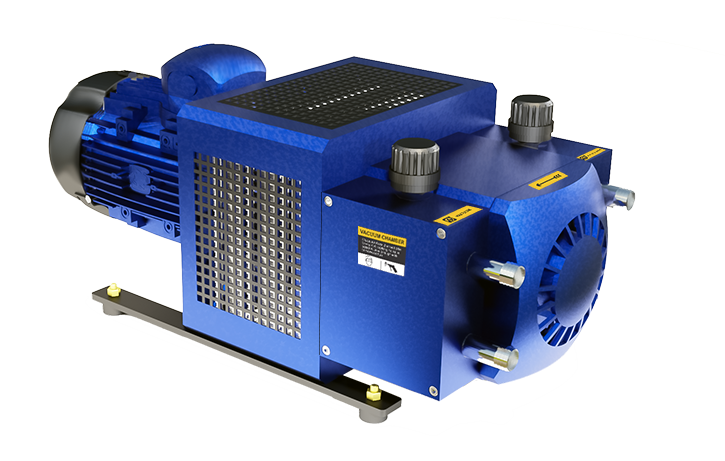 | Dry Vacuum Pressure Pumps Kalbro Manufacturing Co. has been appreciated in the international market as leading Dry Vacuum Pressure Pumps manufacturers, suppliers & exporters. View product → |
Frequently asked questions
Are dry vacuum pressure pumps suitable for chemical plants in Faridabad?
They are suitable when the pump materials, seals, vapour-handling capacity, pressure range and discharge arrangement match the process envelope. Check solvent, acid and condensable-vapour loads before choosing a model.
What does dry mean when pumping solvents, acids and condensable vapours?
Dry means the pumping chamber does not use oil or sealing water for routine operation. It does not mean the process gas is free of liquids, so knock-out pots, condensers, heated lines or compatible scrubbers may still be necessary.
How should you compare dry, oil-lubricated, water-ring and ejector pumps?
Compare ultimate and operating pressure, gas throughput, liquid tolerance, contamination risk, utility demand, corrosion resistance, discharge treatment, maintenance and total operating cost rather than catalogue vacuum alone.
What site and safety issues matter before commissioning a chemical vacuum pump in Faridabad?
Confirm ventilation, electrical classification, earthing, noise control, cooling water or other utilities, exhaust routing, corrosion protection, foundation, access for maintenance and safe handling of solvent or acid vapours.
Keywords