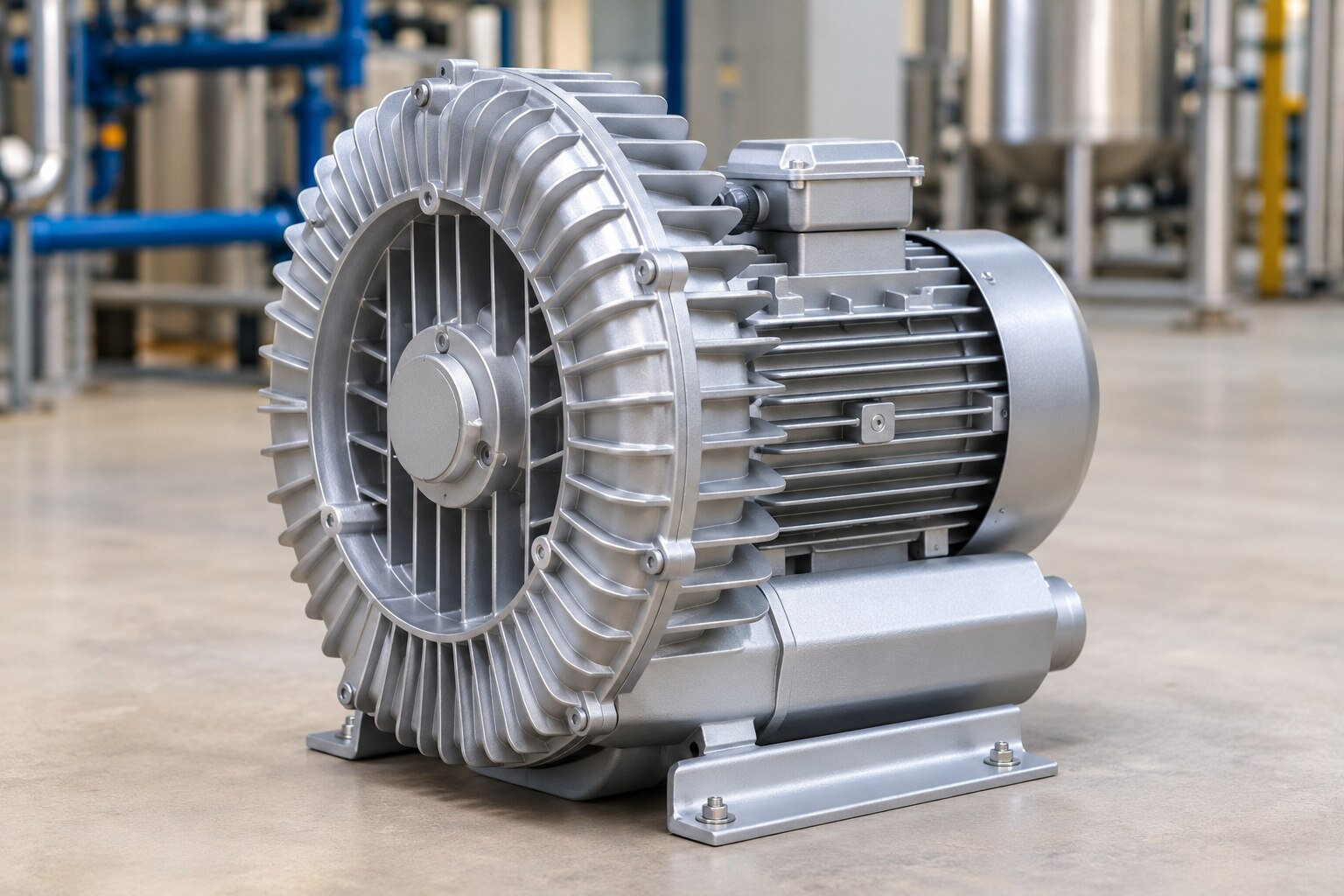
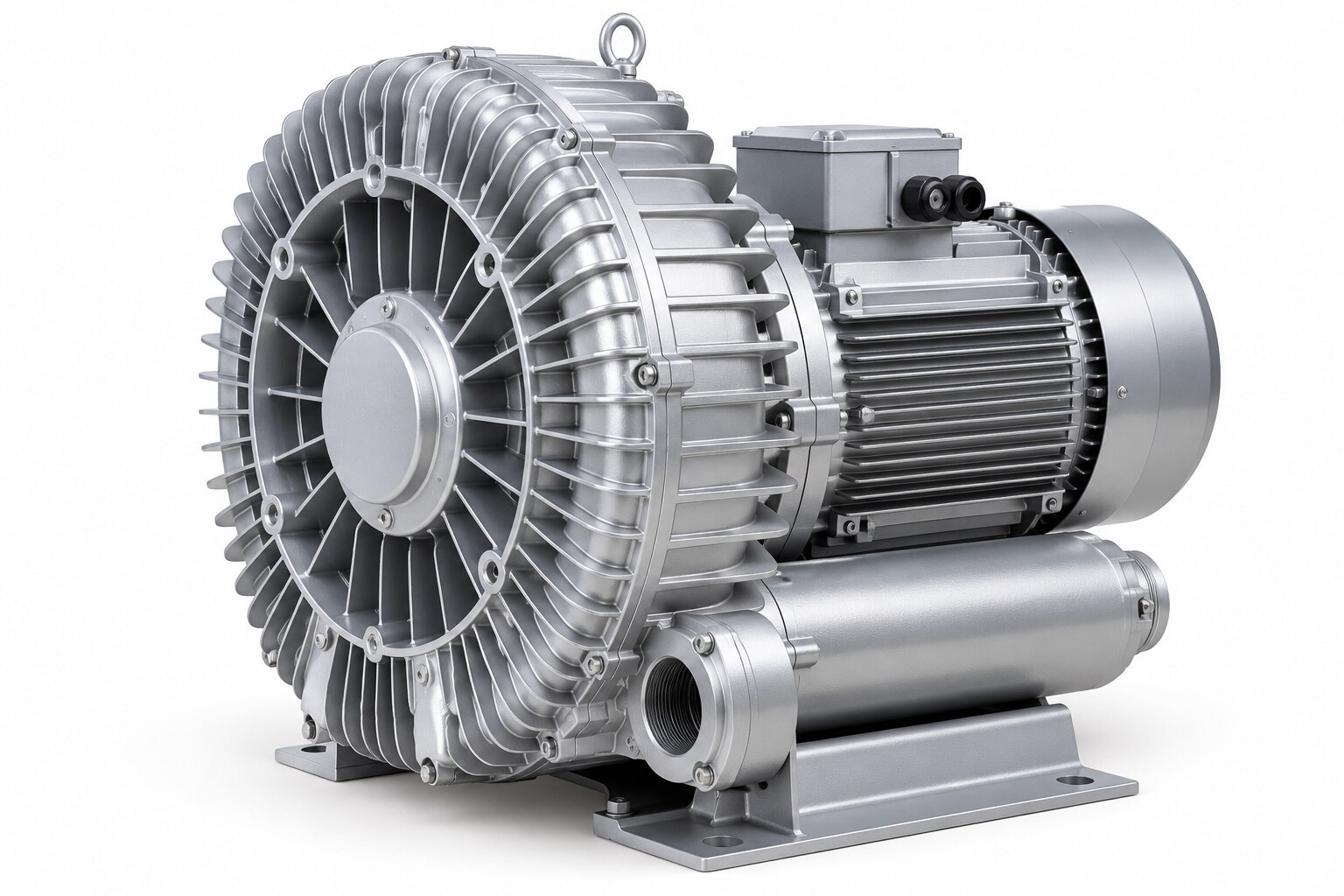
A failed side channel blower can stop conveying, clamping, drying, evacuation or trim collection, but replacing it by motor size or port diameter alone can create a second failure. By the end, you will know how to confirm the fault, define the operating duty, check mechanical and electrical fit, and request a dispatch-ready replacement without guessing.
Key takeaways
- Prove the fault before removing the blower.
- Send model, airflow, pressure, voltage and connection details.
- Match airflow and pressure at the operating point, not motor horsepower.
- Check rotation, mounting, ports, controls and relief protection before dispatch.
Confirm the blower has failed before removing it
Do not remove the blower until you prove the fault is inside the machine. A blocked filter, closed valve, crushed hose or failed relief valve can produce the same low-flow symptom and can damage the replacement.
1. Isolate and lock out the electrical supply. Inspect the inlet filter, pipework, silencers, valves and discharge line for blockage, then confirm that vacuum and pressure relief devices open at their set points.
2. Check the nameplate voltage, phase and frequency against the supply. Verify terminal links, overload settings and rotation direction; a miswired three-phase motor can run backward and deliver little air without being mechanically failed.
3. With the power isolated, check for a seized shaft, rubbing impeller, damaged bearings, burning smell or water ingress. Do not force the shaft or run the blower against a blocked inlet or discharge.
4. Have a qualified technician measure current, differential pressure or vacuum, and airflow during a controlled test. High current with a clear system points to overload, excessive backpressure or mechanical drag; normal current with poor output points to wrong rotation, leakage or a worn impeller.
5. Replace the blower only when the system is clear, the supply and rotation are correct, and the unit still fails to reach its specified duty. Record the actual airflow at operating pressure or vacuum before ordering an urgent side channel blower replacement; motor kW alone cannot identify a suitable unit.
A complete matched assembly can prevent a second failure caused by an incompatible motor, coupling, silencer, filter or relief valve. A failed blower also needs adequate ventilation and thermal clearance, because a replacement in an enclosed space can overheat even with the correct electrical rating.
Send a complete replacement data pack
Send a complete replacement data pack, not a motor rating and port diameter alone. A side channel blower manufacturer in Faridabad can identify a compatible unit faster when the evidence covers duty, electrical supply and physical fit.
- Attach clear photographs of the complete nameplate, terminal box, blower, motor, ports and mounting feet. Type the model number, serial number, motor power, speed and any unreadable nameplate details.
- State the required airflow at the actual operating vacuum or pressure, including units such as m³/h, mbar or kPa.
- Describe the application: pressure, vacuum, alternating vacuum-pressure service, duty cycle, conveyed medium and its temperature.
- Record inlet and outlet diameters, port orientation, rotation direction, mounting-hole spacing, base dimensions and available installation clearance.
- Provide shaft, coupling, adaptor, silencer, filter and relief-valve details if you want to retain existing components.
- Specify supply voltage, phase, frequency, starting method, full-load current, enclosure rating, insulation class and hazardous-area requirements.
- Send the original performance curve, if available, plus photos of connected pipework and any bypass or relief arrangement.
Ask the supplier to quote the model-specific performance curve and dimensional drawing. For urgent work, request a complete matched assembly—blower, motor and protection accessories—rather than a bare blower that leaves the coupling, flange or motor incompatible. Get stock status and tested-unit confirmation in writing.
Match the operating point, not the motor horsepower
Select the blower from its required flow at the actual differential pressure or vacuum. Motor horsepower only indicates the drive rating; a replacement with the same kW can still deliver too little air at your process duty.
Calculate the pressure difference across the machine. For a vacuum application, use the required inlet vacuum and flow. For a pressure application, use discharge pressure and flow. If the process applies pressure on one side and vacuum on the other, add the two gauge differentials to establish the blower’s total duty point.
- Vacuum duty: match flow at the required vacuum, not at free-air capacity.
- Pressure duty: match flow at the required discharge pressure, not the maximum pressure rating.
- Simultaneous vacuum-pressure duty: verify the combined differential pressure and flow on the manufacturer’s performance curve.
Ask a side channel blower manufacturer in faridabad for replacement for the model-specific curve, permitted continuous differential-pressure range, and motor-load data. A published maximum vacuum or pressure is a limit; continuous operation near it raises gas temperature, bearing stress, and motor load. Do not select by port diameter or casing size alone.
Check staging as well. A single-stage and two-stage blower with identical ports and motor ratings can have different pressure, vacuum, and flow performance.
Confirm that the proposed unit covers every operating point, including alternating service, and include correctly sized pressure and vacuum relief protection because a side channel blower must not run against a blocked inlet or discharge.
Check electrical, mechanical and installation compatibility
Before lifting the replacement into place, match its electrical rating, physical interfaces, protection devices and room conditions to the installation.
- Confirm available voltage, phase, frequency, starting method, full-load current, motor speed, insulation class and enclosure protection against the replacement nameplate. Treat 50 Hz and 60 Hz motors as different unless the manufacturer confirms compatibility.
- Measure the inlet and outlet port sizes, flange pattern, orientation, mounting-hole centres, base dimensions and shaft or coupling arrangement. A matching motor cannot rescue a blower that needs altered pipework or an incompatible coupling.
- Check the existing silencer, inlet filter or separator, relief valve, non-return valve, flexible connectors and adaptors. For vacuum duty, retain filtration that stops dust, liquid and process carryover reaching the impeller and bearings.
- Verify hazardous-area classification, earthing, cable-gland size and local starter or variable-frequency-drive requirements before energising the unit.
| Check | Match or verify | Failure if overlooked |
|---|---|---|
| Electrical | Voltage, phase, frequency, starting method, current, protection and hazardous-area rating | Trips, overheating or unsafe operation |
| Mechanical | Port orientation, flange pattern, mounting, coupling, rotation and accessory fit | Rework, leakage or reverse rotation |
| Site | Ventilation, thermal clearance, noise controls and ambient temperature | Thermal overload despite a correct nameplate |
Compare quoted flow on the same basis: free-air delivery, inlet-volume flow, mass flow and flow at specified pressure are not interchangeable. Ask for the inlet temperature, atmospheric pressure, gas composition and reference condition used.
Include filter pressure drop in the duty calculation; a clogged or undersized filter reduces available vacuum flow. For urgent work, a matched assembly can be safer than a bare blower when the motor, coupling or protection devices are uncertain.
Secure a technically correct unit for fast dispatch
Choose an industrial blower supplier in Faridabad that can prove both technical compatibility and physical availability. Ask for the model-specific pressure-flow or vacuum-flow curve, dimensional drawing, and confirmation that the proposed unit is tested, not merely similar in port size or motor horsepower.
Ask the quotation to state:
- Whether the unit is in stock, tested and ready, or build-to-order
- The exact model, stage configuration, motor rating and rotation
- Whether the price covers the matched assembly: blower, motor, silencer, filter, relief valve and adaptors
- Stock location, confirmed dispatch date, carrier or transport mode
- Packing dimensions, gross weight and included accessories
- Whether the stated date means dispatch or delivery
- Warranty start point and the test or inspection record supplied
Treat “side channel blower dispatch” as unconfirmed until these details arrive in writing. A verbal promise can leave you with a bare blower that does not match the flange, coupling, protection device or motor.
Ask Kalbro Vacumatics for a drawing against your mounting dimensions and the operating point, then check ventilation, flexible connectors, noise controls and pressure or vacuum relief protection before accepting an equivalent unit. A supplier that cannot answer those questions clearly is not offering a fast replacement; it is offering a new round of site troubleshooting.
Related product
 | Side Channel Blowers Kalbro Manufacturing Co. is a remarkable Side Channel Blowers manufacturers, suppliers & exporters based in India. View product → |
Frequently asked questions
How do you confirm a side channel blower has failed?
Check the filter, valves, hose, relief valve, electrical supply and motor before removing the blower. A blockage or closed valve can cause low flow without an internal machine fault.
What information should you send for an urgent replacement?
Send the nameplate photograph, model, airflow, pressure or vacuum, motor voltage, frequency, phase, port size, mounting arrangement and application details.
Why should you match the operating point instead of motor horsepower?
The replacement must deliver the required airflow at the system’s actual pressure or vacuum. Two blowers with the same motor horsepower can perform differently at that operating point.
What compatibility checks are needed before dispatch?
Compare electrical ratings, rotation, mounting dimensions, inlet and outlet positions, port sizes, shaft or coupling details, controls, filters and relief protection.
Keywords