A blower that delivers its free-air rating can still fail once filters, bends, elevation, heat and process resistance enter the system. You will be able to classify the available designs, calculate the operating point, read the performance curve and specify protection for Faridabad’s hot, dusty and humid factory conditions.
Key takeaways
- Choose single-stage for lower pressure or vacuum duty and two-stage for higher demand.
- Match the blower to pressure, vacuum, airflow, duty cycle and inlet temperature.
- Allow for Faridabad heat, dust, voltage variation and restricted ventilation.
- Compare operating-point data, noise, service access, filtration and total ownership cost.
Single-stage, two-stage and multistage: what changes between the types?
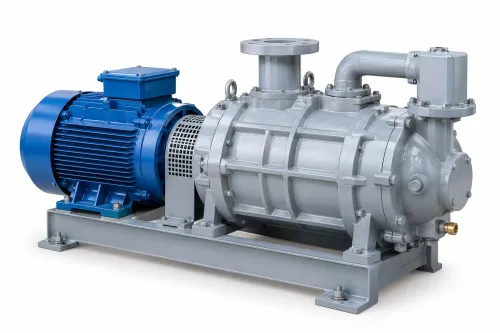
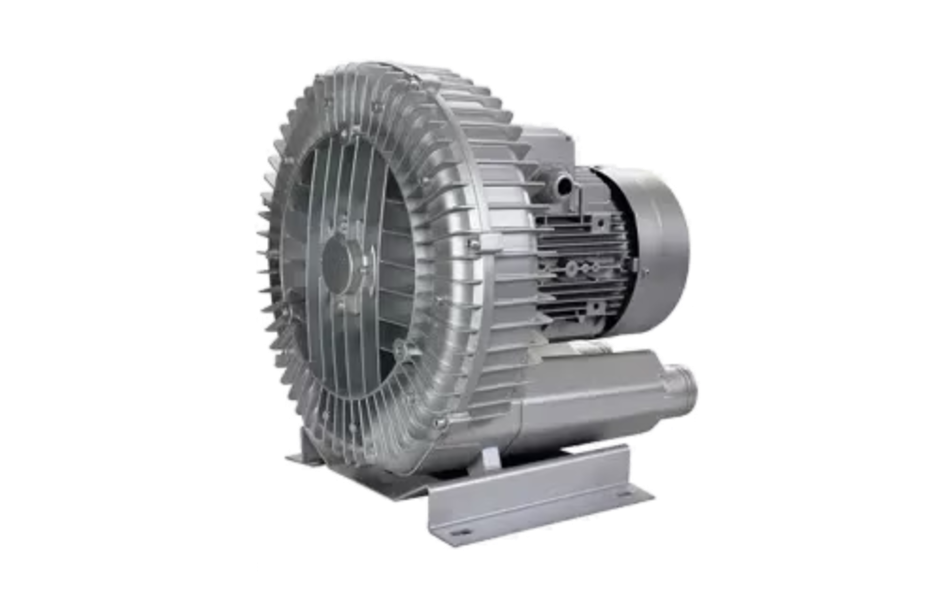
For side channel blower types for factories in Faridabad, the main choice is single-stage or two-stage/multistage. A rotating impeller draws air through the air inlet and accelerates it around the side channel; the air exits through the discharge outlet. The impeller and housing do not touch, so compression is non-contact, but recirculating air generates heat.
| Type | Pressure or vacuum trade-off | Construction |
|---|---|---|
| Single-stage | Higher flow at lower differential pressure | One impeller and side channel |
| Two-stage or multistage | Higher pressure or vacuum differential, usually lower flow than a comparable single-stage unit | Impellers in series |
Select side channel blower models for factories against the operating point, not the maximum headline value. Maximum pressure or maximum vacuum is a limit, not a continuous target: holding it causes heat, motor overload and shortened bearing or insulation life.
- Use a single-stage unit for higher-volume, lower-resistance air movement.
- Use two-stage or multistage units when conveying, lifting or clamping needs greater differential pressure or vacuum.
- Use parallel blowers to increase available flow; use series arrangements to increase differential pressure.
- For either arrangement, check the combined system curve, install non-return valves, balance pressure, and confirm a stopped blower cannot become a bypass path.
A correctly selected curve matters more than simply adding ratings.
Which factory processes need pressure, vacuum or combined duty?
Pressure duty pushes air into a process; vacuum duty removes air from it. Combined vacuum-pressure duty requires both operating directions or separate suction and pressure connections.
| Process | Duty | Suitable blower use |
|---|---|---|
| Conveying | Pressure | Push material through conveying pipe |
| Suction lifting | Vacuum | Lift sheets, boards or components |
| Packaging | Vacuum or combined | Evacuate packs, then supply air for forming or sealing |
| Wastewater aeration | Pressure | Deliver continuous air below the liquid |
| Pneumatic clamping | Pressure | Apply or release actuator force |
| Drying | Pressure or combined | Blow air across parts, with suction for vapour removal |
| Trim or dust collection | Vacuum | Draw waste into ducting and filtration |
A blower rated for pressure service is not automatically safe for vacuum service. Permissible continuous differential pressure, cooling behaviour and the pressure-flow curve can differ in the opposite direction; running at the wrong point can overheat the motor, bearings or housing.
For side channel blower options in Faridabad, fit a pressure-relief valve where a blocked line, closed valve or dead-heading can trap discharge air. Fit a vacuum-relief valve on suction service. Set each valve below the blower’s permissible continuous differential pressure, not at its maximum headline value.
Liquid carryover is not automatically acceptable for a side channel blower. Use a knockout pot, moisture separator or drainable low point when condensation or process liquid can enter, and check the manufacturer’s wet-gas limit.
How do you match a blower to the real operating point?
Specify the duty as 120 m3/min at 350 mbar differential pressure, or 80 m3/hr at 250 mbar vacuum—not as “7.5 kW” or “maximum vacuum.” Build the duty from process demand plus leakage, then add resistance from the pipe, hose, filter, silencer, bends, valves and fittings. Delivered flow falls as resistance rises.
| Selection basis | What it tells you | Risk |
|---|---|---|
| Free-air flow | Capacity with little or no resistance | The blower misses duty after piping and filters are connected |
| Motor horsepower | Electrical input | It does not prove flow at your pressure |
| Maximum vacuum | An end-limit condition | It is not a continuous operating point |
For industrial blower selection in Haryana, read the manufacturer’s pressure-flow curve. Plot the system-resistance curve and select the point where it intersects the blower curve.
Request these quotation figures: guaranteed flow at the stated pressure or vacuum, maximum continuous differential pressure, motor speed and power, and pressure drop across every included filter and silencer.
A correctly selected two-stage unit is preferable when the duty requires higher differential pressure. It can operate on its curve without forcing an oversized single-stage blower against a throttling valve, which wastes power and can increase heat.
What Faridabad conditions do to blower performance and life
Altitude and heat need correction before final selection. Higher altitude lowers air density and changes mass flow; hot ambient air reduces cooling margin, while hot inlet air cuts available pressure and vacuum performance.
For side channel blower types for factories in Faridabad, specify continuous-duty motor rating, overload setting, ventilation and manufacturer derating data for the hot season. Industrial blower selection in Haryana must use the corrected duty point, not catalogue maximums.
1. Treat the inlet filter as part of the blower. Size it for maximum air volume and the actual dust type, then specify a differential-pressure indicator or a stated maintenance limit.
Loading raises pressure drop and reduces delivered flow; a fine filter fitted directly at the inlet can make a correctly sized blower miss its duty.
2. Manage monsoon humidity and process vapour before they reach the blower. Condensation can collect in suction pipes, low points, filters and silencers, so add a moisture separator or knockout pot, or provide drainable low points when required. Check the manufacturer’s wet-gas limits.
3. Install a weather cover, drainage and protection from rain and standing water. IP55 describes motor-enclosure ingress testing; it does not replace process filtration, weather protection or drainage.
How should you compare side channel blower options in Faridabad?
Use the same duty point for every quotation: flow at the required pressure or vacuum, not free-air flow or maximum vacuum. For side channel blower options in Faridabad, inspect the nameplate, electrical panel, pipe route and room temperature during the site review.
| Item | Ask for | Check on site |
|---|---|---|
| Performance | Exact pressure-flow curve, duty-point flow, pressure and vacuum limits | Curve includes the specified operating point |
| Electrical | 50 Hz compatibility; nameplate voltage, such as 380–415 V three-phase; starting current | Supply and protective devices match |
| Motor protection | Continuous-duty rating, enclosure protection, insulation system and overload setting | Settings protect without nuisance trips |
| Connections | Terminal-box arrangement and included accessories | Cable entry, earthing and access are practical |
Compare sound pressure level only when the distance, installation condition and inlet/outlet silencers are stated. Add silencer pressure drop to the system curve, and check piping-borne noise; an acoustic enclosure will not remove vibration travelling through pipework.
For VFD operation, obtain minimum and maximum speed, low-speed motor cooling requirements, resonance regions, bearing limits and the revised performance curve. Do not assume speed control fixes incorrect sizing.
If combustible dust, solvent vapour or explosive gas is present, require an assessment stating zone, gas or dust group, temperature class, earthing and certification. Kalbro Vacumatics can be included in the comparison when its quotation guarantees duty-point data and protection rather than catalogue maximums.
Related product
 | Side Channel Blowers Kalbro Manufacturing Co. is a remarkable Side Channel Blowers manufacturers, suppliers & exporters based in India. View product → |
A final selection worksheet for a Faridabad factory
Write the duty point before comparing side channel blower models for factories. For industrial blower selection in Haryana, use this sequence:
1. Define the duty as pressure, vacuum or combined pressure/vacuum service.
2. Record required flow in m3/hr or m3/min.
3. Record differential pressure or vacuum in mbar, kPa or bar at that flow.
4. Draw or obtain the system-resistance curve, including process demand and leakage.
5. Select single-stage, two-stage or multistage arrangement from the manufacturer’s pressure-flow curve, not from free-air flow or maximum vacuum.
6. Correct the selection for site altitude, ambient temperature and inlet-air temperature.
7. Add pressure losses from the inlet filter, silencer, pipe, hose, bends, valves and fittings.
8. Protect against dust, moisture and blocked lines with suitable filtration, drainage, moisture separation, relief valves and vacuum-relief valves.
9. Complete a hazardous-area review before purchase for combustible dust, solvent vapour or explosive gas, covering zone, group, temperature class, earthing and certification.
10. Confirm motor and electrical compatibility, including 50 Hz supply, nameplate voltage, starting current, continuous-duty rating and overload setting.
At commissioning, verify rotation, measure inlet and discharge pressure, record flow, compare motor current with the nameplate, inspect filter differential pressure and confirm relief-valve settings. Retain the selected curve and these readings as the maintenance baseline.
Frequently asked questions
What changes between single-stage, two-stage and multistage side channel blowers?
Additional impeller stages increase achievable pressure or vacuum, while airflow depends on the blower design and operating point. Single-stage units suit lower-duty applications; two-stage and multistage units suit higher differential pressure or vacuum requirements.
Which factory processes need pressure, vacuum or combined duty?
Use pressure for conveying, aeration and air knives; vacuum for lifting, evacuation and suction; and combined-duty equipment when one system must alternate between suction and blowing. Confirm the required airflow and differential pressure for each process.
How do you match a side channel blower to the real operating point?
Measure required airflow, pressure or vacuum, pipe length, fittings, filters, altitude, inlet temperature and duty cycle. Select a model whose performance curve covers that operating point without relying on a blocked inlet or excessive throttling.
How do Faridabad conditions affect blower performance and service life?
High ambient temperature reduces cooling margin, while dust can load filters and contaminate the air path. Provide clean ventilation, maintain filtration, check motor protection and keep the blower away from hot exhaust air.
How should you compare side channel blower options in Faridabad?
Compare performance curves at the same airflow and pressure or vacuum, motor power, sound level, filtration, cooling arrangement, duty rating, service access, spare parts and warranty terms.
Keywords