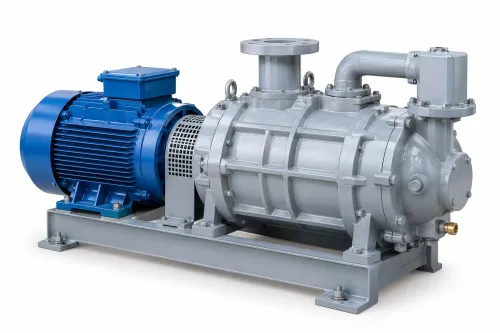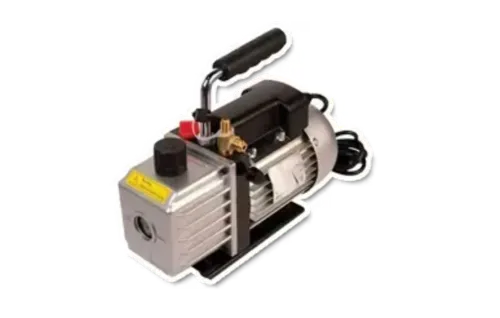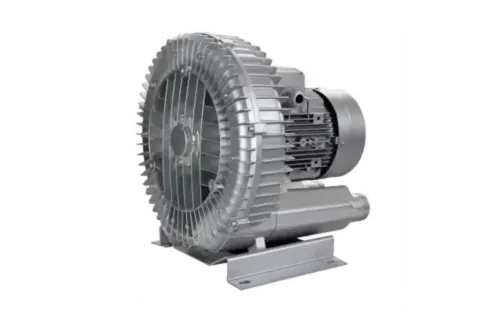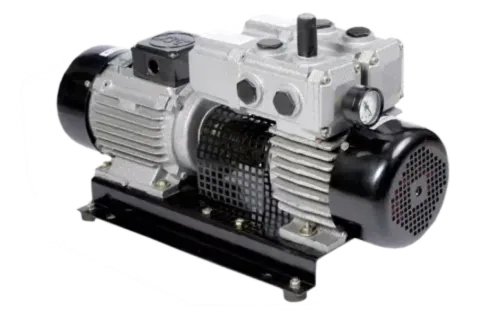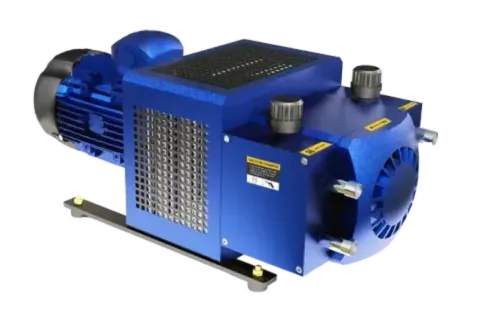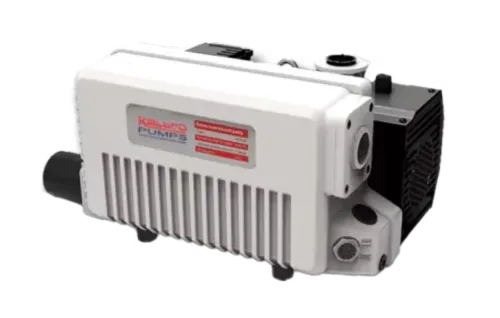
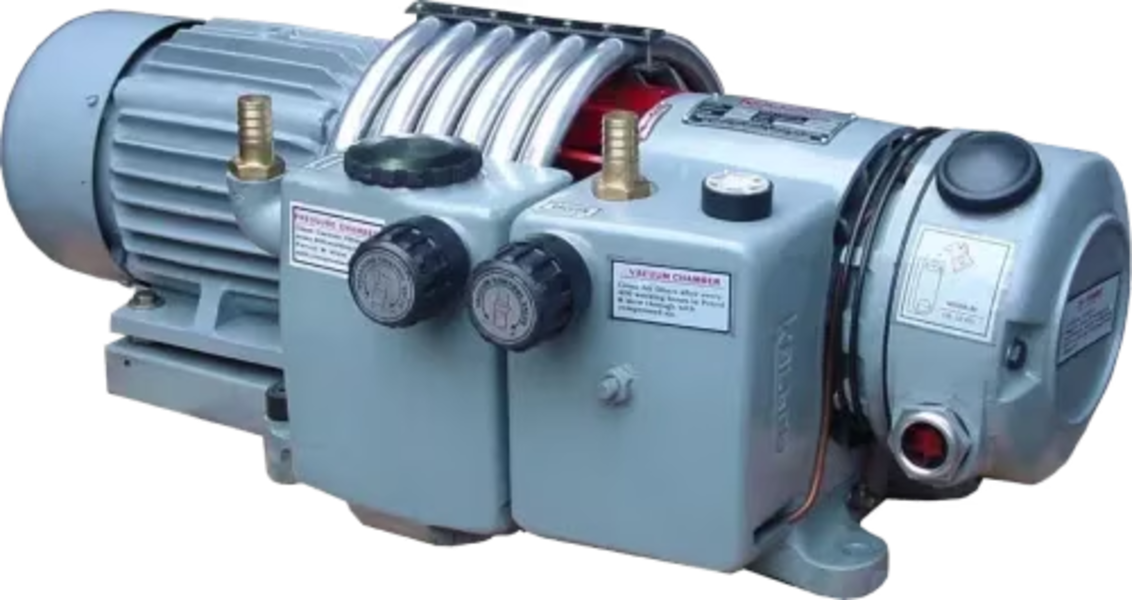
A 30 m3/hr label does not tell you whether a pump will evacuate your packaging chamber within its required cycle time. You need the pressure basis, performance at working vacuum, installation losses, vapour controls, and acceptance tests before approving the equipment or placing an order.
Key takeaways
- Confirm whether 0.8 bar means gauge vacuum or absolute pressure.
- Use a short, wide suction line with an isolation valve and vacuum gauge.
- Size the KB 530 for chamber volume, product moisture, and cycle time.
- Specify an acceptance test using ultimate vacuum, evacuation time, oil condition, and leaks.
Confirm what the KB 530 ratings actually measure
Treat the 0.8 bar figure as unverified until you know its measurement basis. It could mean 0.8 bar below atmospheric pressure, equal to roughly 0.2 bar absolute at sea level, or 0.8 bar absolute pressure; those describe very different packaging results.
Ask for the definition, reference pressure, test temperature, and whether the reading comes from the pump inlet or a machine gauge.
The 30 m3/hr figure also needs context. A nominal displacement or free-air rating is not the pumping speed available at your chamber’s working pressure. Chamber volume, product load, hose restriction, valve size, leakage, and cycle time decide whether a KB 530 for vacuum packaging is adequate.
| Figure | What it means | How to compare it |
|---|---|---|
| 0.8 bar vacuum | Gauge or absolute pressure; confirm which | Match the machine’s required residual pressure |
| 30 m3/hr | Nominal displacement, free-air capacity, or effective speed | Request a performance curve at operating pressure |
| Ultimate vacuum | Isolated pump limit under specified conditions | Do not treat it as chamber pumpdown performance |
| Short demonstration | One unloaded evacuation result | Test the connected machine at production cycle rate |
Before approving the pump, request:
- The manufacturer’s pressure-versus-pumping-speed curve.
- Pumpdown time for your single-chamber, double-chamber, or central-vacuum arrangement.
- Results with the intended product, vapour load, ambient temperature, and cycles per hour.
- Separate blank-off, connected-chamber, and loaded-production tests.
Connect the pump for reliable chamber evacuation
A narrow hose can erase the KB 530’s apparent capacity before the pump reaches its working vacuum. Mount it close to the chamber or sealing head, then use the shortest straight route possible with a smooth-bore hose, full-port fittings, and large-radius bends; avoid unnecessary reducers, tees, and corrugated hose.
Use this connection sequence:
- Chamber machine: connect the pump inlet to the machine’s vacuum port through a full-port isolation valve and an inlet filter or liquid separator. Put the vacuum gauge on the chamber, not only at the pump inlet.
- External-suction unit: connect the suction nozzle to a short, rigid hose and keep the nozzle seal, lid gasket, and filter housing airtight. A long hose between the nozzle and pump slows evacuation.
- Sealing machine: connect the pump to the machine’s designated vacuum port, not the compressed-air or vent port. Confirm that the machine valve opens fully during evacuation and closes before atmospheric venting.
- Exhaust: route the pump exhaust to a ventilated area through the specified separator or mist eliminator; never let the outlet discharge into the machine enclosure.
- Testing: close the isolation valve and leak-test the pipework, fittings, lid, and seals before measuring cycle time. Repeat with the gauge at the chamber.
A vacuum packaging pump in Faridabad still needs the same installation discipline: specify the hose diameter, maximum length, valve type, filter location, and chamber gauge position. Record evacuation time with the actual product and cycle frequency, not only with an empty chamber.
Match the pump to the machine, product, and vapour load
Choose the KB 530 for chamber machines, external-suction units, or tray-sealing work only after checking pumping speed at the machine’s operating pressure. A nominal 30 m3/hr figure alone cannot prove that it will meet the required cycle time.
| Format or condition | Suitability question | Protection or control |
|---|---|---|
| Chamber vacuum bags | Can the pump evacuate the chamber within the specified cycle? | Use a liquid separator, inlet filter, isolation valve, and vapour-capable gas ballast. |
| External-suction bags | Does the nozzle, hose, and seal bar impose excessive restriction? | Keep the hose short and wide; filter dust and prevent liquid slugs. |
| Tray sealers or thermoformers | Is the duty intermittent or continuous, and does the pump speed match production demand? | Check cooling, controls, duty cycle, and effective speed at working pressure. |
| Dry, non-volatile products | Is powder likely to enter the suction line? | Fit a suitable inlet dust filter and inspect pressure drop. |
| Wet, refrigerated, or hot products | What is the permitted inlet vapour load? | Install a condensate trap or liquid separator and use the manufacturer’s gas-ballast or purge procedure. |
| Adhesive or solvent vapour | Are the seals, oil, and elastomers compatible? | Obtain a compatibility decision before connection; add dedicated vapour filtration if specified. |
Water vapour can emulsify oil, reducing vacuum and damaging the pump. Liquid carryover can cause an immediate failure, while powder abrades internal parts and blocks filters.
For KB 530 industrial applications, route exhaust through an oil-mist eliminator or safe exhaust duct, then monitor filter loading, oil level, oil condition, and carryover. Test the connected machine under the actual product load; an isolated-pump vacuum test does not prove packaging performance.
Control oil, exhaust, and package-integrity risks
An oil-sealed pump must not receive liquid, powder, or condensable vapour directly from the packaging chamber. For KB 530 for vacuum packaging, install an inlet filter and a liquid separator or condensate trap, then use gas ballast during moisture-heavy evacuation.
Check oil level, colour, and emulsion before each shift; contaminated oil reduces achievable vacuum and damages bearings and seals.
Use this control set:
- Fit an exhaust mist eliminator sized for the pump’s discharge and replace it when differential pressure rises or oil carryover appears.
- Route exhaust away from operators, open product, and air intakes; provide ventilation if the exhaust remains indoors.
- Add isolation valves so the pump can be serviced without opening the chamber or losing a sealed line.
- Record oil changes, filter loading, trap drainage, operating temperature, and unusual odour in the maintenance log.
A deep pump vacuum does not prove that a finished pack is sound. Close the chamber valve, isolate the pump, and record pressure rise over a defined hold period with a calibrated gauge; a rising reading indicates leakage in the chamber, seals, hose, or valve.
Test sealed packs separately with a vacuum-decay or bubble-emission method, inspect every seal for channels and wrinkles, and reject packs that lose vacuum during the specified hold. For food, reduced-oxygen packaging also requires temperature control, formulation limits, and validated shelf life; the pump is not a food-safety control.
Write a Faridabad purchase specification and acceptance test
A kb 530 vacuum pump order must identify the manufacturer, pump technology, nominal pumping speed, ultimate pressure, motor rating, inlet connection, oil grade, voltage and frequency, and duty cycle. State whether it serves a single-chamber machine, double-chamber machine, or central vacuum system; each requires different receiver volume, isolation valves, peak-flow provision, and redundancy.
Include the target chamber size, evacuation time, cycles per hour, ambient temperature, dust exposure, ventilation, and electrical supply.
Require these documents before commissioning:
- Performance curve showing effective pumping speed at your working vacuum, not only nominal displacement.
- General arrangement drawing, inlet dimensions, rotation direction, wiring diagram, overload setting, and noise figure.
- Oil grade and fill quantity, filter and separator part numbers, service intervals, warranty exclusions, and recommended spares.
- Factory test report and installation checklist; Kalbro Vacumatics can use these details to align the supplied pump with the machine’s actual duty.
| Acceptance check | How to perform it | Evidence to record |
|---|---|---|
| Blank-off vacuum | Isolate the pump from pipework and measure pressure with a calibrated absolute vacuum gauge | Stabilised pressure against the agreed specification |
| Connected-chamber evacuation | Run the normal empty-machine cycle with the installed pipe, valves, filter, and receiver | Time from atmospheric pressure to the agreed setpoint |
| Product-load performance | Repeat production cycles with the real liquid, powder, vapour, and packaging materials | Cycle time, final pressure, oil carryover, exhaust condition, and motor temperature |
Do not accept an installation because the isolated pump reaches vacuum; that result says nothing about chamber leakage, pipe restriction, or sustained production duty.
Related product
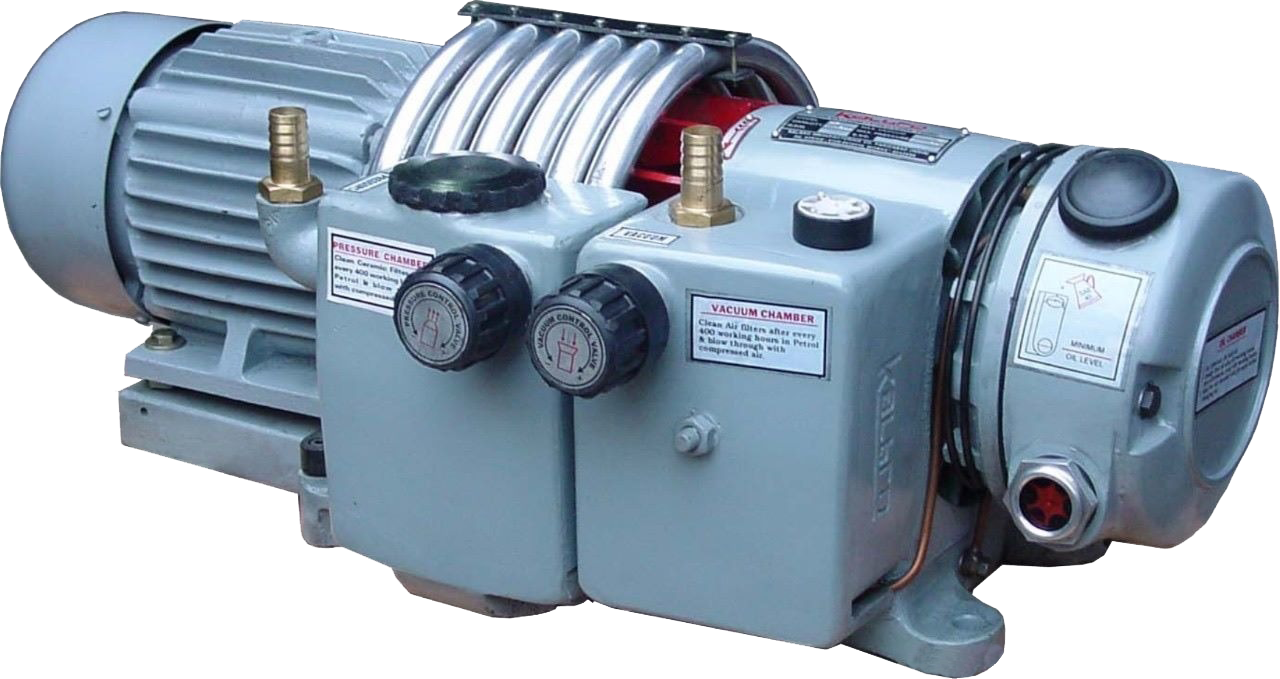 | Oil Lubricated Vacuum Pressure Pump ₹38500 Oil Lubricated vacuum pressure pump Flow : 30 m3/hr Vacuum : 0.8 Bar Pressure : 0.8 Bar Power : 2 hp/ 1.5 kW View product → |
Frequently asked questions
What does the 0.8 bar rating on a KB 530 vacuum pump measure?
Confirm whether it means 0.8 bar below atmospheric pressure or 0.8 bar absolute pressure. At sea level, 0.8 bar gauge vacuum is about 0.2 bar absolute; the two ratings describe different packaging performance.
How should you connect a KB 530 for reliable chamber evacuation?
Use a short, wide suction line, minimise elbows, install an isolation valve and vacuum gauge near the chamber, and check every hose, lid gasket, and fitting for leaks.
How do you match a KB 530 to a vacuum packaging machine?
Compare the pump's measured capacity with chamber volume, target pressure, cycle time, product moisture, vapour load, and the machine's inlet size and duty cycle.
How can you control oil, exhaust, and package-integrity risks?
Use the specified oil, monitor its level and condition, route exhaust safely, protect the pump from liquid carryover, and test seals for leaks, punctures, and incomplete evacuation.
What belongs in a Faridabad KB 530 purchase specification and acceptance test?
State the pressure measurement basis, capacity, motor details, inlet connection, oil type, duty cycle, warranty documents, and site test results for ultimate vacuum, evacuation time, leaks, noise, and temperature.
Keywords